top of page
Vectiva: Understanding Your Diet Through One Unified Score
​

Most people don’t struggle with knowing what they ate — the struggle is knowing what it meant. They see numbers, charts, bars, and percentages scattered across nutrition apps. Calories here. Protein there. Something about fiber. Three vitamins missing. Sodium too high. Potassium too low. It’s overwhelming.
 

At Bimi, we wanted to fix that.
 

We wanted to give people a single, intuitive pulse on their diet — something as easy to grasp as a heartbeat, a compass, or a weather forecast. A way to instantly sense whether a day, week, or month of eating was balanced, lacking, or thriving. Something that doesn’t replace detail, but organizes it into a shape the mind can actually understand.
 

That idea eventually became Vectiva.
 

Where it started: chaos disguised as nutrition data
 

During early development, Bimi’s AI could break a meal into dozens of nutrients; calories, macros, fiber, minerals, vitamins, amino acids, fatty acids. The information was accurate, but the presentation wasn’t digestible. The insights page looked more like a lab report than a reflection of real eating habits.
 

Test users said the same things, over and over:

  • “Okay… but is this good?”

  • “What does all of this add up to?”

  • “Am I on track, or not really?”

  • “I need one number that tells me if I’m doing well.”

It was clear: people wanted a simplified truth without losing scientific rigor.

We needed a way to unify dozens of nutritional signals: and do it in a way that remained personal, scalable, and visually compelling.
 

The breakthrough: thinking in vectors, not categories
 

The insight came when we realized that nutrition isn’t a checklist: it’s a vector field. Every nutrient pulls you toward or away from balance. Each one has a direction (low → optimal → excessive) and a magnitude (how strongly it affects your health over time).

If you stack all of these nutrient vectors together, you get a high-dimensional picture of someone’s nutritional state.

But no one wants to look at a 45-D vector.

They want something they can feel.

So we compressed that high-dimensional field into a single interpretable score, a coverage ratio between what your body likely needed and what your diet actually provided, across a chosen timeframe.

That ratio, averaged across nutrients, becomes a single value between 0 and 1.

From that, Vectiva was born.
 

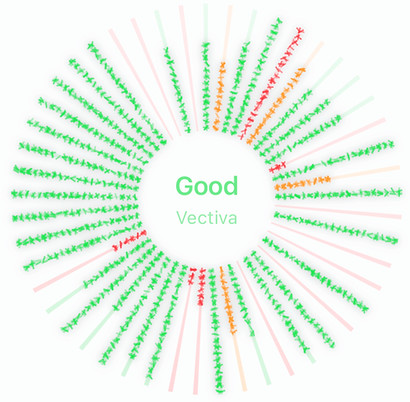
Why a radial chart? Because nutrition is circular, not linear
 

Line charts are great for trends. Bar charts are perfect for comparisons.

But nutrition isn’t just a set of variables, it’s a balance. A ring of interdependent factors.

The radial form felt natural:

  • It shows many nutrients at once

  • It highlights imbalances visually

  • It conveys completeness and deficiency at a glance

The fractured, shimmering tiles add life to the chart. Instead of static rings, the segments feel alive, like metabolism itself. Each tile represents a piece of nutritional contribution, building outward until a nutrient reaches its target.

When a tile is missing, you see it immediately.

When the whole wheel glows evenly, you know your diet was excellent.
 

The name: Vectiva
 

“Vectiva” blends:

  • Vector; the multidimensional nature of nutrition

  • Vita; Latin for “life”

  • Active / Adaptive; its dynamic, personalized interpretation

It’s meant to feel scientific, alive, and human: exactly like the system behind it.
 

How it works under the hood (conceptually)
 

Without revealing specifics of the architecture, the idea is simple:

  1. For every nutrient, we compare your intake to an optimal personal target.

  2. We compute your coverage ratio; how close you were to fulfilling that need.

  3. We limit extremes so one nutrient can’t dominate the score.

  4. We average these coverage values into a single composite metric.

  5. We map the final score into five interpretive labels:

    • Excellent

    • Good

    • Mid

    • Low

    • Critical

This gives users something to feel before they dive deeper.
 

IMG_0512.png
IMG_0513.png

What makes Vectiva different
 

Most nutrition scoring systems rely on hard-coded rules, generic daily averages, or single-day snapshots.
 

Vectiva is:
 

1. Personalized

Nutrient targets adapt to the user's profile whenever possible, while still providing clear feedback even without complete information.

2. Time-aware

You can look at your day, week, month, or year. Longer windows smooth natural fluctuations, giving a clearer sense of habits, not moments.

3. Multidimensional but digestible

It doesn’t ask users to understand 30 charts.
It simply summarizes them.

4. Visually intuitive

You know instantly where you’re doing great - and where you might want to pay attention.
 

Why Vectiva matters

Food is emotional.
Nutrition is complex.
Habits are hard.

People need guidance that is:

  • easy

  • non-judgmental

  • grounded in science

  • instantly understandable

Vectiva achieves that by turning a vast field of nutritional data into a single, meaningful reflection of your eating patterns; a simple compass to guide healthier choices.

It doesn’t tell you what to do.
It shows you where you are.

And that awareness, gently delivered, is often what sparks real change.
 

The journey continues
 

Vectiva is not a static feature; it evolves.

As Bimi becomes smarter; through better food recognition, more precise portion estimation, and deeper nutritional modeling, Vectiva will become an even more accurate mirror of a user’s diet.

Our goal is not perfection.
It’s empowerment.

Vectiva is how we give users clarity in a world overflowing with nutritional noise.
It's the heartbeat of Bimi; one number, one chart, one truth at a time.

bottom of page