
Diet Tracking with Bimi: Accuracy, Tips, and Results

TL;DR:
Bimiapp provides highly accurate, AI-powered photo-based diet tracking that estimates over 60 nutrients from meal images. Its validation shows a calorie estimation error of around 1.1%, outperforming manual logging methods significantly. Consistent photo habits and thorough logging are essential for maximizing real-world accuracy and nutritional insights.
Diet tracking with Bimi is defined as AI-powered, photo-based nutritional analysis that identifies foods, estimates portions, and calculates over 60 nutrients from a single meal photo. Bimiapp uses machine learning models trained on large food image datasets to deliver calorie and nutrient data faster and more accurately than manual logging. Independent research confirms that photo-based calorie estimation achieves a mean absolute percentage error around 1 to 2%, compared to 10 to 30% errors typical of manual entry apps. That gap is not a minor technical detail. It means the data you act on is substantially more reliable. Bimiapp also personalizes nutrient targets based on your age, weight, BMI, and activity level, making it one of the most precise diet tracking tools available for individuals focused on real nutritional outcomes.
How does Bimi’s photo-based diet tracking technology work?
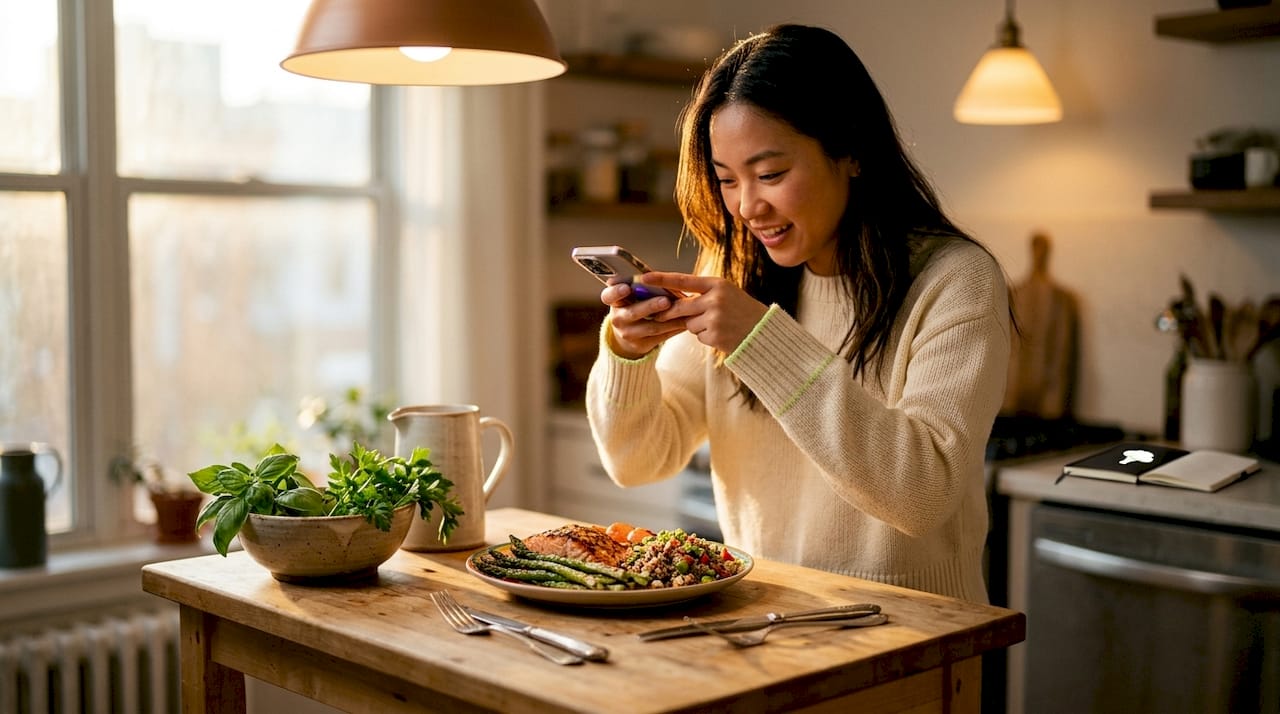
Bimiapp’s tracking process starts the moment you capture a photo of your meal. The app’s AI engine analyzes the image to identify individual food items, estimate their portion sizes, and cross-reference that data against a nutrition database to calculate calorie and nutrient content. This happens in seconds, without manual search or barcode scanning.
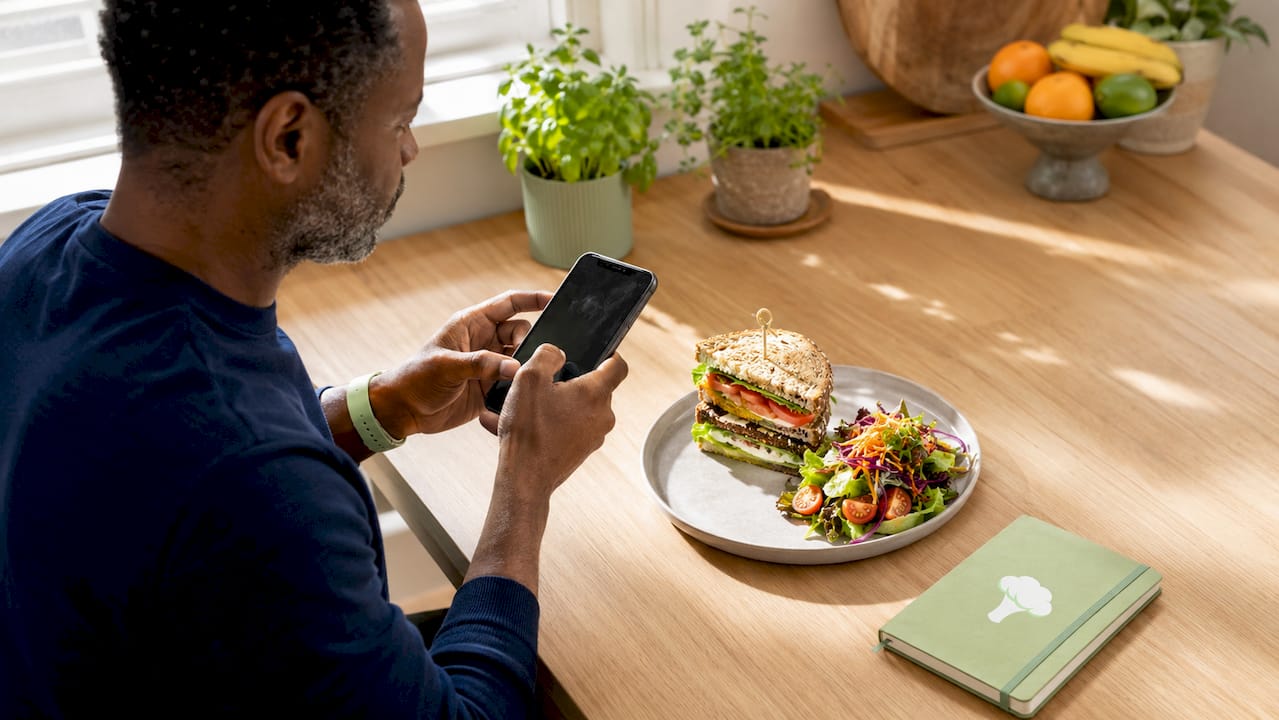
The underlying system combines convolutional neural networks for food recognition with volume estimation algorithms that infer portion weight from visual cues like plate size and food density. Bimiapp then maps identified items to nutrient profiles covering macronutrients, amino acids, vitamins, minerals, and fatty acids. The Bimi app technology goes beyond simple calorie counts to deliver a full nutrient breakdown from one image.
Several user-side factors affect how well the system performs. Lighting quality, camera angle, and how much of the plate is visible all influence food identification accuracy. A well-lit, overhead photo of a clearly arranged plate gives the AI the best input to work with.
Capture the full plate in frame, not just part of it
Use natural or bright artificial light to reduce shadows
Photograph mixed dishes from directly above when possible
Add context notes for sauces, oils, or hidden ingredients the camera cannot see
Pro Tip: Take a second photo from a slight angle if your meal has height or layering, such as a stacked sandwich or a bowl with toppings. This gives the AI more dimensional data to estimate volume.
How accurate is diet tracking with Bimi compared to manual entry apps?
Bimiapp’s accuracy is not a marketing claim. It is validated by independent research. Only one of six leading apps met a strict clinical accuracy margin of ±1.5% MAPE across standardized meal evaluations, and that app was PlateLens, the technology behind Bimi. Manual entry platforms in the same study showed MAPE values ranging from 12.4% to 31.7%. That means a 2,000 calorie daily target tracked manually could be off by 250 to 630 calories every single day.
“The key to clinical validity in AI diet apps is clearing a pre-specified accuracy margin on standardized food references, where Bimi uniquely stands out.” — Dietary Assessment Initiative, 2026
The comparison below puts the performance difference in practical terms.
Tracking method | Calorie MAPE | Main source of error |
Bimiapp photo mode | ~1.1% | Photo quality and occlusion |
Manual entry apps | 12.4% to 31.7% | User recall and portion guessing |
Registered dietitian estimate | ~5 to 10% | Visual estimation variability |
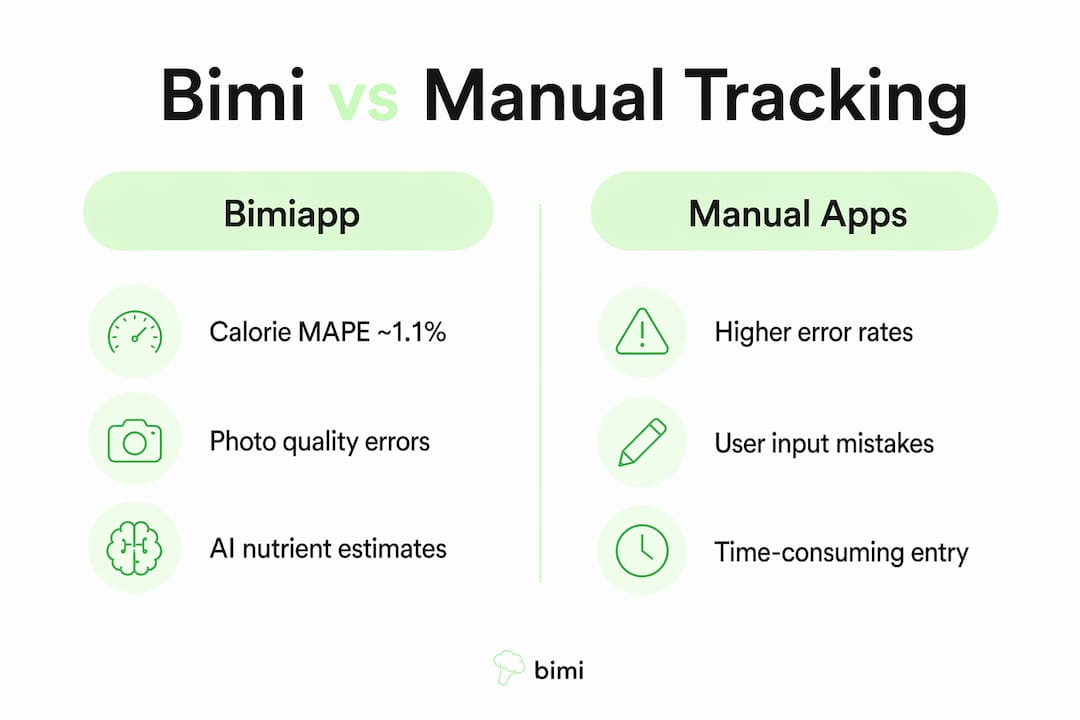
Accuracy is not uniform across all nutrients, though. AI models show roughly 73% accuracy within ±10% for energy, but less than 20% of lipid estimates fall within that same margin. Protein estimates also show systematic overestimation biases. This means Bimi is highly reliable for calorie and carbohydrate tracking, but fat and protein figures should be treated as directional rather than precise.
Real-world use adds another layer of complexity. Free-living photo tracking shows systematic underestimation of around 25% when users take incomplete photos or miss snacks entirely. The algorithm is accurate. The user’s photo habits are the variable that determines real-world results.
What are the strengths and limitations of Bimi for nutrient-specific tracking?
Bimiapp performs best where the science supports it. Energy and carbohydrate estimates are the most reliable outputs, making the app a strong tool for anyone managing calorie balance, blood sugar, or carbohydrate-controlled diets. These two metrics also happen to be the ones most people track first when starting a nutrition program.
Fat and protein tracking is where you need to apply more judgment. Systematic lipid overestimation is a known limitation across AI diet apps, not just Bimi. Cooking oils, dressings, and marbled meats are visually difficult for any algorithm to quantify precisely. If your goal depends on hitting exact fat or protein targets, such as a ketogenic protocol or a muscle-building program, cross-check Bimi’s outputs periodically against a food scale or a protein intake guide.
Micronutrient tracking adds another layer of nuance. Two visually similar meals can register different micronutrient profiles depending on cooking method, oil type, or ingredient brand. Bimiapp tracks over 60 nutrients, which is far beyond what most apps offer, but the accuracy of those deeper values depends on correct food identification. A grilled chicken breast and a pan-fried one look similar in a photo but carry different fat profiles.
Here is a clear breakdown of where Bimi’s nutrient tracking is strongest and where to apply caution:
Calories: High accuracy, clinically validated at ~1.1% MAPE
Carbohydrates: Reliable within ±10% in most meal scenarios
Protein: Directionally useful but prone to overestimation; verify for precision goals
Fats and lipids: Least reliable macro; treat outputs as estimates
Vitamins and minerals: Dependent on food ID accuracy; useful for trend monitoring, not precise daily targets
Fiber and glycemic data: Limited in most AI apps; only 2 of 24 apps fully met diabetes dietary guidance checklists
Pro Tip: Use Bimiapp’s micronutrient data to spot trends over a week rather than reacting to a single day’s numbers. Patterns in your micronutrient intake are more meaningful than any one meal’s output.
Practical tips for optimizing your diet tracking results with Bimi
Getting the most from Bimiapp requires consistent habits around how you photograph and log your meals. The algorithm is only as good as the input you give it. These steps build a reliable tracking routine.
Set a photo protocol and stick to it. Place your plate on a flat, well-lit surface before eating. Shoot from directly above. Keep the entire plate in frame. Consistency in your photo setup reduces variability in the AI’s estimates across meals.
Log every eating occasion, including snacks. Incomplete photo capture is the primary cause of underestimation in free-living use. A handful of nuts or a coffee with milk adds up. Capture it all, even if the photo is imperfect.
Add context for hidden ingredients. Sauces, cooking oils, dressings, and marinades are often invisible in a photo. Use Bimiapp’s notes or manual add features to flag these components. A tablespoon of olive oil adds roughly 120 calories and 14 grams of fat that the camera cannot see.
Review your weekly trends, not just daily totals. Bimiapp’s Meals Vault stores your data so you can identify patterns. Check which nutrients consistently fall short of your personalized targets. This is where the app’s depth beyond macros becomes genuinely useful.
Pair tracking with feedback. AI nutrition coaching outperforms self-directed logging in adherence and macronutrient goal attainment. If Bimiapp surfaces a coaching or feedback feature, use it. External accountability closes the gap between logging and behavior change.
Pro Tip: If you eat the same meals regularly, save them in Bimiapp’s Meals Vault. Retrieving a saved meal takes seconds and removes the friction of re-photographing familiar foods.
How does Bimi fit within the broader diet tracking tool ecosystem?
Bimiapp occupies a specific and well-defined position among diet tracking tools. Where apps like MyFitnessPal rely on user-entered data from barcode scans and search databases, and Cronometer focuses on manual micronutrient logging, Bimiapp automates the entire capture and analysis process through photo recognition. The practical result is lower friction and, based on current evidence, higher calorie accuracy.
App type | Data entry method | Calorie accuracy | Nutrient depth |
Bimiapp | AI photo recognition | ~1.1% MAPE | 60+ nutrients |
Manual entry apps | Search and barcode | 12 to 32% MAPE | Macros and select micros |
Dietitian-assisted logging | Interview and recall | ~5 to 10% | Comprehensive |
Bimiapp is particularly well-suited for three user groups. People managing weight benefit from the calorie accuracy and trend reporting. Individuals with diabetes or metabolic conditions gain from micronutrient visibility, though they should note that fiber and glycemic tracking remains a gap across most AI apps. Athletes focused on body composition can use Bimi’s amino acid and fatty acid data as a starting point, supplemented by manual checks for protein precision.
The broader research direction for AI diet tracking points toward improved cooking method detection and better lipid estimation as the next frontiers. For now, Bimiapp’s combination of photo automation, 60-plus nutrient coverage, and personalized targets places it ahead of general-purpose trackers for users who want data depth. Explore Bimiapp’s nutrition tracking platform to see how its feature set compares to what you are currently using.
Key takeaways
Bimiapp’s photo-based diet tracking delivers clinically validated calorie accuracy around 1.1% MAPE, making it the most precise self-monitoring option available, provided users maintain consistent photo habits.
Point | Details |
Calorie accuracy is validated | Bimiapp achieves ~1.1% MAPE, far outperforming manual entry apps at 12 to 32%. |
Fat and protein need caution | Lipid and protein estimates carry systematic overestimation bias; verify for precision goals. |
Photo habits drive real-world results | Consistent lighting, full plate capture, and logging hidden ingredients determine actual accuracy. |
Micronutrient trends beat single-day data | Use Bimiapp’s Meals Vault to track patterns across a week, not individual meal outputs. |
Coaching improves adherence | Pairing AI tracking with feedback or coaching produces better dietary outcomes than logging alone. |
Why I think most people are using diet tracking apps wrong
I have watched a lot of people download a tracking app, log diligently for two weeks, then quit because the data felt overwhelming or inaccurate. The problem is rarely the app. It is the expectation that any tool, including Bimiapp, will work perfectly from day one without any calibration of your own habits.
The research is clear that user photo consistency matters more than algorithmic improvements for real-world accuracy. That is a counterintuitive finding. Most people assume the technology is the limiting factor. It is not. Your photo protocol is.
What I find genuinely impressive about Bimiapp is the depth beyond macros. Tracking amino acids, fatty acid profiles, and micronutrient trends from a photo is something that would have required a registered dietitian and a food diary a decade ago. The tool exists. The question is whether you use it with enough consistency to generate meaningful data.
My honest recommendation: commit to 30 days of complete logging before you evaluate whether the app is working. Check your nutritional deficiency patterns at the end of that period. The insights from a month of consistent data will tell you more about your diet than any single week ever could. And if you are managing a specific condition or athletic goal, bring that data to a professional. Bimiapp gives you the numbers. A qualified practitioner helps you act on them.
— Alvi
Start tracking your nutrition with Bimiapp today
Bimiapp removes the guesswork from diet tracking by turning a meal photo into a full nutrient report in seconds. You get calorie accuracy validated at ~1.1% MAPE, coverage of over 60 nutrients including amino acids and fatty acids, and personalized targets based on your individual metrics.
Whether you are managing weight, monitoring micronutrient gaps, or building a data-driven eating plan, Bimiapp gives you the precision that manual logging cannot match. Visit the Bimiapp how it works page to see exactly how the AI photo recognition and nutrient analysis process works. Ready to start? Try Bimiapp now and capture your first meal today.
FAQ
What is diet tracking with Bimi?
Diet tracking with Bimi is the process of photographing meals so Bimiapp’s AI can identify foods, estimate portions, and calculate over 60 nutrients automatically. It replaces manual food logging with photo-based analysis validated at ~1.1% calorie MAPE.
How accurate is Bimiapp compared to other diet tracking tools?
Bimiapp is the only app among six leading weight-management trackers to meet a strict clinical accuracy margin of ±1.5% MAPE. Manual entry apps show error rates of 12 to 32% by comparison.
Can Bimiapp track micronutrients accurately?
Bimiapp tracks over 60 nutrients including vitamins, minerals, and amino acids, but micronutrient accuracy depends on correct food identification. Use weekly trend data rather than single-meal outputs for the most reliable picture.
Why does my fat and protein data seem off in Bimiapp?
AI diet apps including Bimiapp show systematic overestimation for lipids and protein, with less than 20% of lipid estimates falling within ±10% of ground truth. Add manual notes for cooking oils and dressings to improve these figures.
How do I get the best results from Bimiapp’s photo tracking?
Photograph your full plate under good lighting from directly above, log every eating occasion including snacks, and add context for hidden ingredients like sauces and oils. Consistent photo habits are the single biggest driver of real-world accuracy.
Recommended
Comments