
Dietary Reference Values Explained for Better Health


TL;DR:
Dietary reference values are population-based benchmarks used to guide nutrient intake for maintaining health and preventing deficiencies.
They include metrics like the RDA, AI, UL, and AMDR, which are set through systematic reviews and updated as new research emerges.
Dietary reference values (DRVs) are scientifically derived nutrient intake levels designed to maintain health and prevent deficiencies in healthy populations. The term “dietary reference values” is the broader category name used by bodies like the European Food Safety Authority (EFSA), while the United States uses the umbrella term Dietary Reference Intakes (DRIs). Both systems include specific metrics: the Recommended Dietary Allowance (RDA), Adequate Intake (AI), Tolerable Upper Intake Level (UL), and Acceptable Macronutrient Distribution Ranges (AMDR). The National Academy of Medicine sets these values for the US, reviewing population nutrient data and safety margins to establish each figure. Knowing how to read and apply these numbers gives you a real advantage in managing your nutrition, whether you are addressing a deficiency or planning a healthier diet.
What are the main types of dietary reference values?
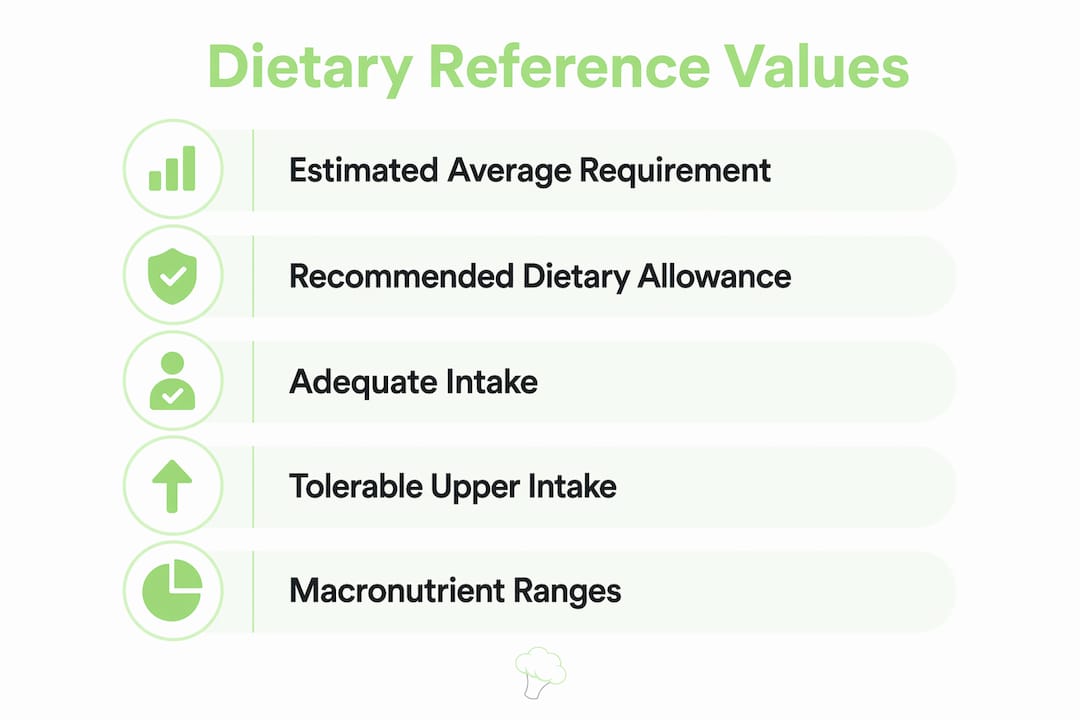
DRVs are not a single number. They are a family of related metrics, each serving a different purpose in nutrition planning.

The Estimated Average Requirement (EAR) is the intake level that meets the needs of exactly 50% of healthy individuals in a specific life-stage and gender group. Scientists use the EAR as the statistical foundation for calculating the RDA.
The Recommended Dietary Allowance (RDA) builds on the EAR by adding a safety margin. The RDA covers 97.5% of healthy individuals within a given group, typically set about 20% higher than the EAR. That margin exists because individual needs vary, and a population-level guideline must account for the full range of variation.
The Adequate Intake (AI) applies when researchers lack enough data to calculate a reliable EAR and RDA. The AI is an observed or experimentally derived estimate. Calcium and vitamin D recommendations for infants, for example, rely on AI rather than RDA.
The Tolerable Upper Intake Level (UL) marks the highest daily intake unlikely to cause harm. Exceeding the UL raises toxicity risk. A clear example: the zinc UL is 40 mg per day in the US, compared to 25 mg per day set by EFSA for adults. That gap reflects different risk assessment methods between agencies.
The Acceptable Macronutrient Distribution Ranges (AMDR) express macronutrient targets as a percentage of total daily calories. The AMDR for fat, for instance, is 20%–35% of total energy intake for adults.
Different regions use different labels for similar concepts. The US RDA corresponds roughly to the Population Reference Intake (PRI) used by EFSA. Knowing these equivalents helps you read international nutrition research without confusion.
How are dietary reference values determined and updated?
DRVs are not set once and forgotten. They follow a structured review process, and they change as new research emerges.
Systematic evidence review. Expert panels from bodies like the National Academy of Medicine examine clinical trials, observational studies, and metabolic research to identify the intake level that prevents deficiency in most people.
Statistical modeling. Scientists calculate the EAR from population requirement data, then derive the RDA by adding two standard deviations. The protein RDA, for example, represents the mean requirement plus two standard deviations, covering approximately 97.5% of the population.
Safety margin assessment. For the UL, panels evaluate adverse effect data and apply uncertainty factors. This step explains why US and EFSA ULs sometimes differ for the same nutrient.
Periodic revision. The 2025–2030 Dietary Guidelines for Americans updated protein recommendations to 1.2–1.6 grams per kilogram of body weight per day, up from the previous 0.8 g/kg. That shift reflects growing evidence on muscle maintenance, aging, and metabolic health.
Funding and feasibility constraints. Some nutrient values have not been re-evaluated in over a decade due to limited research funding. Older DRVs for certain vitamins and minerals may not reflect the most current evidence.
Pro Tip: When you read a nutrition label or supplement fact sheet, check the year the DRV it references was last updated. Older benchmarks for some nutrients may not reflect current science.
The gap between US and EFSA values is not an error. It reflects genuinely different methodologies and risk thresholds. Understanding that difference helps you interpret international nutrition guidance without assuming one system is simply wrong.
How should you apply dietary reference values to your own nutrition?
DRVs are population averages. They are not a personal prescription. Applying them well requires understanding what they can and cannot tell you about your individual needs.
Daily Values on food labels are a starting point, not a finish line. Labels use standard calorie assumptions that do not match every person’s metabolic needs. A 2,000-calorie reference diet works for many adults, but not for a 70-year-old sedentary woman or a 25-year-old male endurance athlete. Labels are most useful for comparing products, not for strict daily tracking.
Track patterns over time, not single-day totals. Nutrient intake viewed over weeks or months gives a far more accurate picture of adequacy than any single day’s tally. Missing your calcium target on a Tuesday is not a problem. Consistently falling short for months is.
Key factors that shift your personal nutrient needs away from the standard DRV include:
Age. Older adults need more protein and vitamin D than the general adult RDA reflects.
Activity level. Endurance athletes require higher carbohydrate and electrolyte intakes than sedentary adults.
Health status. Conditions like celiac disease, Crohn’s disease, or kidney disease alter absorption and excretion of specific nutrients.
Genetics. Variants in genes like MTHFR affect folate metabolism, meaning the standard folate RDA may not be adequate for some people.
Pregnancy and lactation. DRVs include separate values for these life stages because nutrient demands increase significantly.
For personalized nutrient targets, you need to layer your individual context on top of the population baseline. The RDA tells you where most healthy people land. Your genetics, lifestyle, and health history tell you where you actually are.
Pro Tip: Use the AMDR as a flexible range rather than a fixed ratio. If your fat intake sits at 32% of calories one week and 28% the next, you are well within the 20%–35% range and do not need to adjust.
The 2025–2030 guidelines also continue to limit saturated fat to less than 10% of daily calories. That figure is a DRV-adjacent recommendation grounded in cardiovascular disease research, and it applies broadly across healthy adult populations.
What are common misconceptions about dietary reference values?
The biggest misconception about DRVs is that you must hit your RDA every single day. That belief creates unnecessary anxiety and often leads to over-supplementation.
“Nutrition acronyms like DRI and RDA are designed for population-level health policy, not precise individual daily meal planning. The numbers serve as benchmarks to assess adequacy over long periods.” — Dr. Steven Hertzler, as cited by IDEA Health & Fitness Association
That framing matters. DRVs function as policy tools to guide public health decisions, food fortification programs, and dietary guidelines. They were never designed to tell you exactly what to eat for lunch.
A second widespread misconception is that more is always better. The UL exists precisely because excess intake of fat-soluble vitamins, iron, zinc, and other nutrients causes real harm. Exceeding the zinc UL of 40 mg per day, for example, can suppress copper absorption and impair immune function.
A third misunderstanding involves the food matrix concept. Nutrients do not act in isolation inside whole foods. The food matrix in whole foods affects how nutrients are digested and absorbed, which is why eating 500 mg of calcium from dairy produces different physiological effects than swallowing a 500 mg calcium supplement. DRVs set targets for nutrients, but whole foods deliver those nutrients in forms the body uses more effectively.
Clinical dietitian Hannah K. Brilling advocates for sustainable whole-food patterns rather than rigid nutrient targets. That perspective aligns with the 2025–2030 guidelines’ shift toward food quality. Dr. Dariush Mozaffarian similarly emphasizes avoiding highly processed foods, noting that highly processed foods make up roughly 60% of the US food supply and are linked to chronic disease. The new guidelines mark a clear move away from nutrient-only thinking toward whole-food-based nutrition.
For a deeper look at how nutritional balance indicators translate DRVs into real-life practice, the gap between knowing a number and eating well is where most people need the most support.
Key Takeaways
Dietary reference values are population-based benchmarks, not personal daily targets, and applying them effectively requires tracking patterns over time while accounting for individual factors like age, genetics, and health status.
Point | Details |
RDA covers 97.5% of healthy people | The RDA includes a safety margin above the EAR to account for individual variation in nutrient needs. |
UL marks the safe upper limit | Exceeding the UL for nutrients like zinc or vitamin A increases toxicity risk, not health benefit. |
Track patterns, not daily totals | Nutrient adequacy is best assessed over weeks or months, not a single day’s intake. |
Food quality matters as much as numbers | Whole foods deliver nutrients in forms the body absorbs more effectively than isolated supplements. |
Individual context shifts your needs | Age, activity, genetics, and health conditions all move your personal requirements away from the population average. |
Why I think most people use DRVs the wrong way
The most common mistake I see is treating the RDA like a daily checklist. People obsess over hitting 1,000 mg of calcium or 15 mg of iron every single day, then feel like they have failed when they fall short. That is not what these numbers were built for.
DRVs were designed by researchers studying populations, not individuals. The RDA tells you where the bar is set for a healthy adult in your life stage. It does not tell you whether you personally need more or less based on your absorption rate, your gut health, or your training load. Those variables matter enormously, and no single population average can capture them.
What actually works, in my experience, is building a diet around whole foods first and using DRVs as a sanity check, not a daily scorecard. If your weekly average for a nutrient consistently falls below the EAR, that is a signal worth investigating. If you hit 80% of your RDA most days and 120% on others, you are almost certainly fine.
The 2025–2030 guidelines’ shift toward food quality over nutrient counting is the most practical update in years. Focusing on daily nutrient balance through whole foods naturally brings most nutrients into range without requiring a spreadsheet. Reserve the detailed tracking for specific deficiencies or health conditions where precision actually matters.
— Alvi
How Bimiapp helps you put dietary reference values into practice
Knowing your DRVs is one thing. Seeing how your actual meals measure up is another.

Bimiapp tracks over 60 nutrients, including vitamins, minerals, amino acids, and fatty acids, using your personal metrics like age, weight, BMI, and activity level to set targets grounded in DRV science. The AI food recognition feature lets you log meals by photo, so you spend less time entering data and more time understanding your patterns. The Meals Vault stores your intake history, making it easy to spot trends over weeks rather than fixating on a single day. Visit the how it works page to see how Bimiapp translates population-level DRVs into personalized nutrient guidance built around your body and your goals.
FAQ
What does “dietary reference value” mean?
A dietary reference value is a scientifically established nutrient intake level used to guide healthy diets in a population. The term covers several metrics, including the RDA, AI, UL, and AMDR, each serving a different purpose in nutrition planning.
Is the RDA the same as the daily value on food labels?
No. The RDA is a research-based intake target for a specific life stage and gender group, while the Daily Value on labels is a simplified figure based on a standard 2,000-calorie diet. Labels are useful for comparing products but do not reflect individual metabolic needs.
What happens if you exceed the tolerable upper intake level?
Exceeding the UL raises the risk of toxicity or adverse effects. For zinc, surpassing 40 mg per day can impair copper absorption and weaken immune function. The UL is not a target; it is a ceiling.
How often are dietary reference values updated?
The US updates its Dietary Guidelines for Americans every five years. The most recent cycle produced the 2025–2030 guidelines, which raised protein recommendations to 1.2–1.6 g/kg per day and reinforced limits on saturated fat and processed food intake.
Do DRVs apply to people with health conditions or deficiencies?
DRVs are set for healthy populations and do not account for disease-related changes in absorption or metabolism. People with conditions like celiac disease, kidney disease, or confirmed nutrient deficiencies should work with a healthcare provider to establish individual targets.
Recommended
Comments