
Explain Adaptive Nutrition: Your 2026 Practical Guide


TL;DR:
Adaptive nutrition continuously updates dietary advice based on real-time biological data and lifestyle feedback. It outperforms static diets by improving adherence and clinical markers within 6 to 18 weeks. Proper use relies on ongoing data collection and translating insights into practical meal plans.
Adaptive nutrition is defined as a dynamic, personalized dietary approach that continuously adjusts food recommendations based on an individual’s biological data, lifestyle changes, and real-time feedback. Unlike a fixed meal plan, it treats your body as a moving target. Your metabolism, gut microbiome, stress hormones, and activity level shift daily. A diet that worked last month may not serve you today. 68% of consumers now use personalized nutrition tools, a 340% increase since 2022. That number signals a fundamental shift in how people think about food and health.
What does “explain adaptive nutrition” actually mean?
Adaptive nutrition, also called personalized dynamic nutrition in clinical literature, is the practice of using ongoing biological signals to update your dietary plan in real time. The core idea is simple: your body changes, and your diet should change with it. Static plans ignore this reality. Adaptive systems are built around it.
The approach draws from three data sources: your metabolic responses, your gut microbiome composition, and your lifestyle patterns. Each of these varies significantly from person to person. Gut microbiome composition varies up to 80% between individuals, which directly affects how your body responds to the same meal. Two people eating identical breakfasts can have completely different blood sugar responses.
Adaptive nutrition captures that variability and uses it to build a plan that fits you specifically. It is not a one-time setup. Adaptive nutrition is a continuous, iterative process requiring daily physiological data inputs. Think of it less like a prescription and more like a feedback loop that gets sharper over time.
How does adaptive nutrition work scientifically?
The science behind adaptive nutrition sits at the intersection of biology, data collection, and machine learning. Understanding each layer helps you evaluate whether a given tool or approach is genuinely adaptive or just a rebranded static plan.

The biological inputs
Your body produces measurable signals that reflect its current state. Key inputs include:
Metabolic markers: Blood glucose variability, insulin sensitivity, and resting metabolic rate tell a system how efficiently you process carbohydrates and fats.
Microbiome data: Stool analysis identifies bacterial strains that influence digestion, inflammation, and nutrient absorption. Your nutrient bioaccessibility depends heavily on this microbial environment.
Genetic markers: Variants in genes like MTHFR or APOE affect folate metabolism and fat processing, respectively.
Wearable device data: Continuous glucose monitors, heart rate variability trackers, and sleep sensors provide real-time physiological context.
Hormonal signals: Cortisol levels, for example, signal stress states that affect muscle retention and fat storage. True adaptive nutrition adjusts macros dynamically based on hormonal signals like cortisol to prevent muscle loss during caloric deficits.
How AI processes the data
Once data is collected, machine learning algorithms identify patterns and generate recommendations. Advanced AI systems predict individual metabolic responses to foods with 85% accuracy by integrating microbiome, genetic, and wearable data. That level of accuracy is not achievable with a generic food pyramid. Reinforcement learning in adaptive nutrition systems optimizes recommendations for long-term engagement but requires careful safety constraints to avoid harmful advice.
Pro Tip: When evaluating any adaptive nutrition platform, ask whether its algorithm updates recommendations weekly or only at setup. A system that never updates is not adaptive. It is just personalized at the start.
What are the measurable benefits of adaptive nutrition?
The evidence for adaptive nutrition has grown substantially through 2025 and 2026. The results across clinical and consumer settings are consistent: people who follow adaptive plans do better than those on static diets across multiple health markers.
Individuals using adaptive nutrition protocols achieve 73% higher long-term adherence and reach health goals 2.4 times faster than those on static diets. Adherence is the single biggest predictor of dietary success. A plan you follow beats a perfect plan you abandon.
Specific clinical markers also improve. Personalized interventions improve weight loss, HbA1c, and triglycerides, though measurable effects typically take 6–18 weeks to appear. HbA1c reflects average blood sugar over three months, making it a reliable long-term indicator. Triglyceride reduction signals improved fat metabolism and lower cardiovascular risk.
“Personalized nutrition adherence owes more to contextualizing advice to an individual’s habits than clinical precision alone. The most accurate plan fails if it does not fit the person’s daily life.”
The table below summarizes key outcome data from recent research:
Health Marker | Outcome with Adaptive Nutrition |
Long-term dietary adherence | 73% higher than static plans |
Speed of health goal attainment | 2.4 times faster |
Weight management improvement | 47% better reported outcomes |
Energy level increase | 38% improvement reported |
Time to measurable clinical effects | 6–18 weeks |
Digital personalized nutrition delivered remotely produced consistent weight loss and adherence improvements without in-person contact. That finding matters because it means you do not need a clinical setting to benefit. A well-designed app with real data inputs can produce real results.
How is adaptive nutrition different from a standard diet plan?
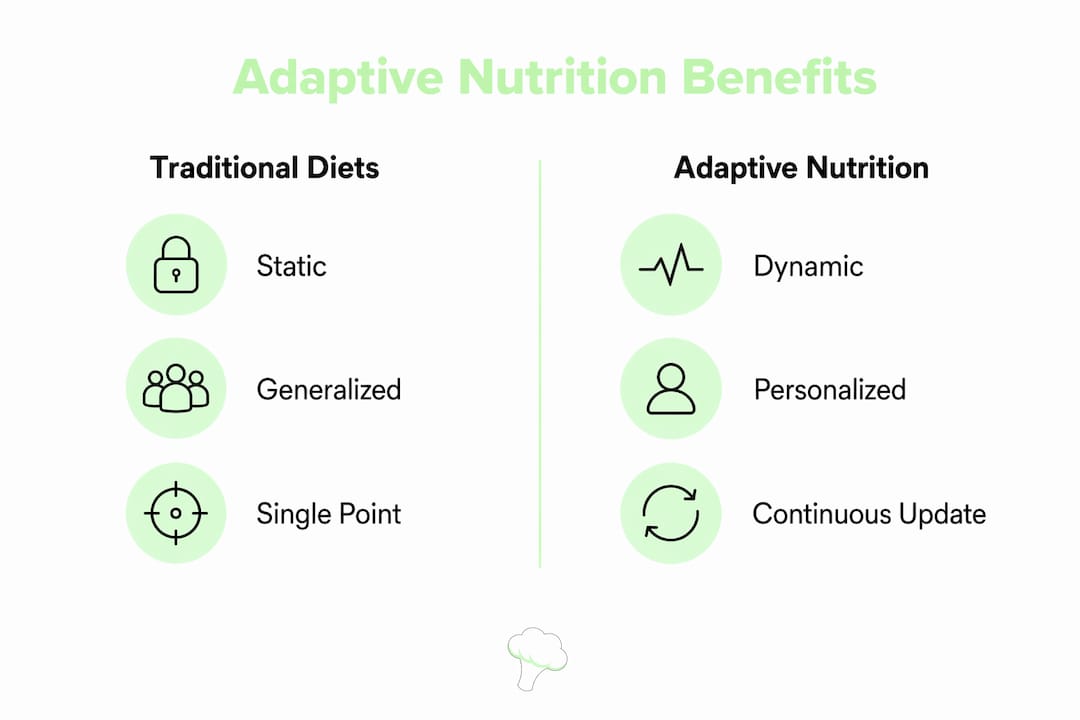
Most diet plans are static. They assign you a calorie target and a macronutrient split based on your starting stats, then leave you to follow it indefinitely. Static diet plans often fail due to lack of iterative adaptation. Your body adapts to a fixed plan, your goals shift, and the plan becomes misaligned with your actual needs.
Adaptive nutrition replaces that single-point setup with a continuous feedback loop. Your data comes in, the system processes it, and your recommendations update. The loop repeats. This is the core structural difference.
The depth of personalization also differs. Standard plans typically adjust for age, weight, and activity level. Adaptive systems go further, incorporating hormonal cycles, sleep quality, stress markers, and microbiome shifts. Many “personalized” nutrition tools lack true adaptability, relying on outdated rule engines rather than integrating hormonal and contextual data. A rule engine says “if BMI is over 25, reduce carbs.” A context-aware model asks why BMI is elevated and adjusts accordingly.
Pro Tip: Before committing to any nutrition platform, check whether it tracks more than macros. Monitoring amino acids, fatty acids, and micronutrients gives you the full picture that adaptive nutrition requires. Bimiapp tracks over 60 nutrients for exactly this reason.
The practical difference shows up in outcomes. Adaptive plans account for the fact that your body on a Monday after poor sleep is not the same as your body on a Friday after a strong training week. A static plan treats both days identically. Adaptive nutrition does not. For a deeper look at personalizing nutrient targets to your specific goals, the distinction becomes even clearer.
What adaptive nutrition strategies can you apply right now?
You do not need a clinical research team to start using adaptive nutrition principles. The following strategies work for health-conscious individuals at any starting point.
Track continuously, not occasionally. Logging meals once a week gives you a snapshot. Daily tracking gives you a pattern. Patterns are what adaptive systems need to make useful adjustments.
Add a wearable data layer. A continuous glucose monitor or a heart rate variability tracker adds physiological context that food logs alone cannot provide. Even basic sleep tracking reveals recovery patterns that affect your nutritional needs.
Choose platforms with transparent algorithms. Prefer platforms with transparent algorithmic logic to avoid unregulated “black-box” advice lacking clinical validation. If a platform cannot explain why it made a recommendation, treat that recommendation with caution.
Pair data with practical meal tools. The highest success rates come from combining automated insights with practical tools like meal boxes and optimized grocery lists to reduce decision fatigue. Data without a practical translation layer rarely changes behavior.
Build consistent input habits first. The quality of adaptive recommendations depends entirely on the quality of data going in. Inconsistent logging produces inconsistent guidance. Commit to daily input for at least six weeks before evaluating results.
Monitor micronutrients, not just macros. Deficiencies in magnesium, vitamin D, or omega-3 fatty acids affect energy, sleep, and inflammation. These gaps rarely show up in macro-only tracking. Use a platform that covers the full nutrient tracking methodology to catch what standard apps miss.
Key Takeaways
Adaptive nutrition outperforms static diets because it treats your body as a dynamic system and adjusts recommendations continuously based on real biological data, not fixed rules.
Point | Details |
Core definition | Adaptive nutrition continuously updates dietary recommendations based on biological data and lifestyle feedback. |
Adherence advantage | People on adaptive plans show 73% higher long-term adherence than those on static diets. |
Clinical timeline | Measurable improvements in HbA1c, triglycerides, and weight typically appear within 6–18 weeks. |
Technology requirement | Effective adaptive nutrition requires wearable data, microbiome inputs, or AI-driven analysis, not just calorie counting. |
Practical success factor | Pairing data insights with meal planning tools reduces decision fatigue and drives real behavior change. |
Why I think most people are using adaptive nutrition wrong
Most people who try adaptive nutrition focus entirely on the data collection side and ignore the translation layer. They buy a glucose monitor, sync it to an app, and then stare at charts without knowing what to do next. The data is there. The behavior change is not.
The real value of adaptive nutrition is not the algorithm. It is what the algorithm tells you to eat for lunch today, given everything it knows about you. Success in adaptive nutrition depends heavily on the translation layer that converts data-driven insights into convenient meal plans and grocery lists. Without that layer, most people give up within a month.
I also think the industry has a transparency problem. Too many platforms make recommendations without explaining the reasoning. That is a clinical risk, not just a UX flaw. When a system tells you to cut saturated fat without explaining that your specific triglyceride pattern or genetic variant drives that advice, you have no way to evaluate whether the recommendation is sound. Blind trust in algorithmic black boxes is not adaptive nutrition. It is just outsourcing your diet to software.
The people who get the most out of adaptive nutrition treat it as a learning process. They use the data to build self-knowledge, not just to receive instructions. Over time, they understand their own metabolic patterns well enough to make good food decisions even without the app open. That is the real goal. Technology should build your capacity, not replace your judgment.
— Alvi
How Bimiapp supports your adaptive nutrition practice
Putting adaptive nutrition into practice requires a tool that goes beyond basic calorie counting.
Bimiapp tracks over 60 nutrients, including amino acids, vitamins, minerals, and fatty acids, giving you the full nutritional picture that adaptive approaches depend on. The platform uses AI-driven food photo recognition to log meals quickly, estimates portion sizes automatically, and generates personalized nutrient recommendations based on your age, weight, BMI, and activity level. The Meals Vault feature stores your meal history locally so you can review trends and spot deficiencies over time. For anyone serious about applying personalized nutrition tracking to their daily habits, Bimiapp provides the data depth and practical tools that make the difference between collecting numbers and actually changing your diet.
FAQ
What is adaptive nutrition in simple terms?
Adaptive nutrition is a dietary approach that continuously updates your food recommendations based on your biological data, such as blood sugar, gut microbiome, and activity level, rather than following a fixed plan.
How long does adaptive nutrition take to show results?
Clinical research shows measurable improvements in weight, HbA1c, and triglycerides typically appear within 6–18 weeks of following a personalized adaptive nutrition protocol.
Is adaptive nutrition only for athletes?
Adaptive nutrition benefits anyone whose health goals, lifestyle, or biology changes over time, which includes most people. Athletes use it for performance, but it is equally effective for weight management, metabolic health, and energy improvement.
What data does adaptive nutrition require?
Effective adaptive nutrition draws from food logs, wearable device data, microbiome analysis, and genetic markers. At minimum, consistent daily food tracking with micronutrient detail gives the system enough input to generate useful adjustments.
How is adaptive nutrition different from a personalized diet plan?
A personalized diet plan is set once based on your starting stats. Adaptive nutrition updates continuously as your body and lifestyle change, creating a feedback loop that a one-time plan cannot replicate.
Recommended
Comments