
Macronutrient Ratios Explained: Your 2026 Guide


TL;DR:
Macronutrient ratios are the percentage of daily calories from protein, carbohydrates, and fat, and they influence energy production and body composition. Customizing these ratios involves setting protein and fat first based on body weight, then adjusting carbohydrates to meet calorie goals. Reassessing macro targets every few weeks with real data ensures optimal results for different activity levels and goals.
Macronutrient ratios are defined as the percentage of daily calories that come from protein, carbohydrates, and fat. These three nutrients shape how your body produces energy, builds muscle, regulates hormones, and controls hunger. The National Academy of Sciences sets the Acceptable Macronutrient Distribution Ranges (AMDR) for healthy adults at 45–65% carbohydrates, 10–35% protein, and 20–35% fat. Getting these ratios right matters whether your goal is weight loss, muscle gain, or simply eating a balanced diet. This guide explains macronutrient ratios from the ground up and shows you how to set them for your specific goals.
What are macronutrient ratios and why do they matter?
Macronutrient ratios describe how your total daily calories split among the three primary nutrients. Each macro serves a distinct biological role. Protein builds muscle, produces enzymes and hormones, and supports immune function. Carbohydrates supply fast energy for your brain and working muscles. Fats maintain cell membranes, support hormone production, and help your body absorb fat-soluble vitamins.

The ratio you choose directly affects your body composition and energy levels. A person eating 2,000 calories at a 50/25/25 split (carbs/protein/fat) gets a very different physiological response than someone eating the same calories at 30/40/30. Understanding this macronutrient breakdown is the first step toward making your diet work for you rather than against you.
Calorie density per gram also matters when you build your ratios. Protein and carbohydrates each deliver 4 kcal per gram. Fat delivers 9 kcal per gram. That gap means fat-heavy diets pack more calories into smaller portions, which affects satiety and total intake in ways that pure percentage math can miss.
Macronutrient | Calories per gram | AMDR range |
Carbohydrates | 4 kcal | 45–65% |
Protein | 4 kcal | 10–35% |
Fat | 9 kcal | 20–35% |
How do you customize macronutrient ratios for fat loss, muscle gain, or maintenance?
Customizing your macro ratios starts with your goal, not a preset percentage. The most reliable method sets protein first, fat second, and fills the remaining calories with carbohydrates.
Pro Tip: Never start with percentages. Start with grams based on your body weight. Percentages follow naturally once your protein and fat floors are set.
Here is a practical three-step process:
Set your protein target. Experts recommend 1.6–2.2 g of protein per kilogram of body weight for muscle retention and satiety. A 75 kg person targets 120–165 g of protein daily. Multiply grams by 4 to get calories from protein.
Set your fat floor. A minimum of 0.6 g of fat per kilogram of body weight supports endocrine function. For that same 75 kg person, that means at least 45 g of fat per day. Multiply by 9 for fat calories.
Fill the rest with carbohydrates. Subtract protein and fat calories from your total daily calorie target. The remainder goes to carbs. Divide by 4 to get grams.
For fat loss, a caloric deficit of 300–500 calories below your Total Daily Energy Expenditure (TDEE) produces roughly 0.5–1 pound of weight loss per week while protecting lean muscle. For muscle gain, a modest surplus of 200–300 calories above maintenance limits excess fat storage while supporting growth.
The practical result is that carbohydrates become the flexible variable. You raise or lower carbs to hit your calorie target without touching your protein or fat minimums. This approach protects the macros your body needs most while giving you room to adjust based on how you feel and perform.
How does activity level affect your ideal macronutrient balance?
Physical activity changes your macro needs more than almost any other factor. The type of training you do determines which macros to prioritize.
Strength training increases protein demand for muscle repair and growth. People lifting weights four or more days per week typically land at the higher end of the protein range, around 2.0–2.2 g/kg.
Endurance training raises carbohydrate needs. Runners, cyclists, and swimmers rely on glycogen stores for sustained output. Endurance athletes need more carbohydrates to replenish what training burns.
Mixed training (CrossFit, team sports, circuit work) calls for moderate protein and moderate to high carbs, with fat held near the minimum floor.
Sedentary or lightly active people can function well at the lower end of carbohydrate ranges, since glycogen demand is low.
Personalizing macronutrient ratios to your individual activity level and goal maximizes both health and performance benefits. A ratio that works for a marathon runner will not work for someone focused on body recomposition, even at the same calorie total. The macro breakdown must match the physiological demand you place on your body each week.
Carbohydrates are the most flexible macro because they fuel training volume and energy balance without compromising protein or fat requirements. Protein and fat needs stay relatively stable across activity levels. Carbs move up or down based on training load and personal preference.
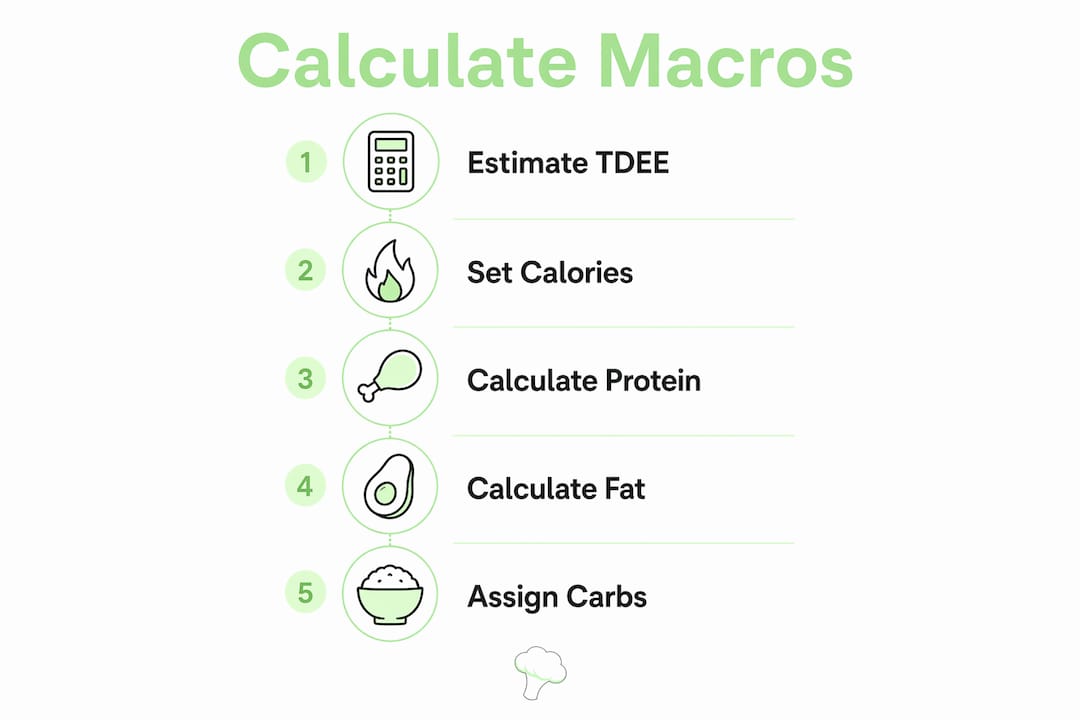
How to calculate your macronutrient ratios step by step
Calculating your macros requires a starting point, a method, and a willingness to adjust. Here is how to do it correctly.
Step 1: Estimate your TDEE
Your Total Daily Energy Expenditure is the number of calories your body burns in a day, including activity. Use a TDEE calculator that accounts for your age, weight, height, and activity level. This number becomes your maintenance baseline.
Step 2: Set your calorie goal
Decide whether you want to lose fat, gain muscle, or maintain weight. Apply the appropriate deficit or surplus to your TDEE. Write down your target calorie number before touching any macro percentages.
Step 3: Calculate protein and fat in grams
Apply the body weight formulas from the customization section above. Convert grams to calories. These two numbers are fixed until your body weight changes significantly.
Step 4: Assign remaining calories to carbohydrates
Subtract protein and fat calories from your total. Divide the remainder by 4. That is your daily carbohydrate target in grams.
Pro Tip: Log your intake for two full weeks before making any changes. Your first calculation is an estimate. Real data from your own body is what refines it.
Starting with percentages alone often leads to inadequate protein intake, especially at lower calorie targets. The gram-first method prevents that error. Successful macro tracking requires iteration over 2–4 weeks with body composition and energy level monitoring. Your metabolism is not a fixed equation. Adjust every few weeks based on real results, not just the math.
A useful macronutrient analysis checklist can help you review your intake systematically and catch gaps before they affect your progress. Tracking also reveals patterns, like low energy on training days, that point directly to a carbohydrate shortfall rather than a protein or fat issue.
Goal | Calorie adjustment | Protein (g/kg) | Fat (g/kg) | Carbs |
Fat loss | 300–500 kcal deficit | 1.8–2.2 | 0.6–0.8 | Remainder |
Muscle gain | 200–300 kcal surplus | 1.6–2.0 | 0.8–1.0 | Remainder |
Maintenance | At TDEE | 1.6–1.8 | 0.8–1.0 | Remainder |
Key Takeaways
The most effective approach to macronutrient ratios is to set protein and fat in grams first, then use carbohydrates as a flexible variable to meet your calorie target and training demands.
Point | Details |
AMDR defines the baseline | The National Academy of Sciences sets carbs at 45–65%, protein at 10–35%, and fat at 20–35% of daily calories. |
Protein anchors every plan | Target 1.6–2.2 g per kilogram of body weight to protect muscle and control hunger. |
Fat has a non-negotiable floor | Minimum 0.6 g per kilogram of body weight keeps hormones and cell function intact. |
Carbs are the flexible variable | Adjust carbohydrate intake up or down to hit your calorie target without touching protein or fat. |
Iteration beats perfection | Recalculate every 2–4 weeks using real body composition and energy data, not just formulas. |
Why I think most people set their macros backwards
Most people I see start with a macro percentage split they found online, then try to fit their life into it. That approach almost always fails. The percentage tells you nothing useful until you know your calorie target and your protein floor in grams.
The real mistake is treating all three macros as equally flexible. Protein and fat are not flexible. Protein protects your muscle and keeps you full. Fat keeps your hormones working. Cut either one too low and you will feel it within days. Carbohydrates are the lever. They go up on hard training days and down on rest days. They absorb the calorie adjustments that fat loss or muscle gain requires.
Patience matters more than precision in the first few weeks. Your body needs time to respond to a new intake pattern. Changing your ratios every few days based on the scale is the fastest way to confuse yourself and abandon the plan. Set your targets, personalize your nutrient targets based on your actual goals, and give the numbers at least two weeks before drawing conclusions.
Personal experimentation is not optional. Metabolic variability is real. Two people with identical stats can respond differently to the same macro split. The person who succeeds long term is the one who tracks honestly, adjusts based on data, and treats their nutrition plan as a working document rather than a fixed rule.
— Alvi
How Bimiapp helps you track and adjust your macros
Knowing your macro targets is only half the work. Hitting them consistently requires tracking, and tracking requires a tool that does not slow you down.

Bimiapp uses AI food recognition to log meals from a photo, estimates portion sizes automatically, and maps your intake against personalized macro targets based on your age, weight, BMI, and activity level. The platform monitors over 60 nutrients, so you see the full picture beyond just protein, carbs, and fat. The Meals Vault stores your meal history locally, letting you review trends and generate reports that show exactly where your ratios drift over time. See how it works and set up your personalized macro targets today.
FAQ
What are macronutrient ratios?
Macronutrient ratios are the percentage of daily calories that come from protein, carbohydrates, and fat. The National Academy of Sciences recommends 45–65% carbs, 10–35% protein, and 20–35% fat for healthy adults.
What is the best macronutrient ratio for weight loss?
A fat loss ratio typically keeps protein at 1.8–2.2 g per kilogram of body weight, fat at a minimum of 0.6 g per kilogram, and fills remaining calories with carbohydrates at a 300–500 calorie daily deficit.
How do I calculate my macronutrients?
Start by calculating your TDEE, then set your calorie goal. Assign protein and fat in grams based on body weight, convert to calories, and allocate the remaining calories to carbohydrates.
How often should I adjust my macro ratios?
Reassess your macro targets every 2–4 weeks using body composition changes and energy levels as your guide. Initial calculator outputs are estimates that need real-world refinement.
Do macronutrient ratios change with exercise type?
Yes. Strength training raises protein needs, while endurance training increases carbohydrate requirements to replenish glycogen. Fat intake stays near its minimum floor regardless of training type.
Recommended
Comments