
How to Identify Hidden Nutrient Gaps in Your Diet


TL;DR:
Hidden nutrient gaps are subclinical shortages that impair body function before symptoms appear.
Combining dietary intake logging, symptom tracking, and targeted blood tests effectively detects these hidden deficiencies.
Hidden nutrient gaps are subclinical shortages of essential vitamins and minerals that impair body function before any obvious symptom appears. The clinical term for this state is “subclinical deficiency,” and it describes a condition where your intake falls short of what your body needs to perform at its best, even though standard lab work may look normal. Knowing how to identify hidden nutrient gaps matters because vitamin D deficiency alone affects 41.6% of U.S. adults. That figure means nearly half the population carries a gap they likely do not know about. The most commonly affected nutrients are B12, vitamin D, iron, magnesium, and zinc.
How can dietary intake analysis help detect hidden nutrient gaps?
Dietary intake analysis is the first and most accessible step in any nutritional gap assessment. It compares what you actually eat against established Recommended Dietary Allowances (RDAs) for each nutrient. Gaps become visible when your average intake consistently falls below those targets across multiple days.

The most practical way to start is to log your meals for at least three to seven days, including weekends. A single day of tracking misses the natural variation in your diet. Three to seven days gives a realistic picture of your typical intake patterns.
Here is a step-by-step approach to dietary intake analysis:
Log every meal and snack. Record portion sizes as accurately as possible. Photo-based logging tools, like those offered by Bimiapp, use AI to recognize food and estimate portions, which removes much of the manual guesswork.
Compare your intake to RDAs. Check each micronutrient against the RDA for your age, sex, and activity level. Pay close attention to B12, vitamin D, iron, magnesium, and zinc, since these are the most commonly under-consumed.
Use a micronutrient gap calculator. Gap calculators translate shortfalls into practical food serving suggestions, showing you exactly how many servings of spinach or salmon would close a specific gap. This makes the data usable, not just informative.
Run a deficiency risk screener. Risk screeners factor in your diet pattern, life stage, symptoms, and medications to flag which nutrients deserve a closer look. They do not diagnose deficiencies, but they sharpen the focus before you speak with a clinician.
Diet diversity is a strong protective factor. Eating from fewer than five distinct food groups daily raises the probability of multiple micronutrient shortfalls. Variety across vegetables, proteins, whole grains, dairy or fortified alternatives, and healthy fats covers a broader range of nutrients than any single “superfood” approach.
Pro Tip: Track your intake for a full week before drawing any conclusions. A single day of logging often reflects an unusually good or bad eating day, not your real baseline.
Intake analysis has real limits. It cannot account for absorption differences caused by gut health, medications, or cooking methods. Treat it as a screening layer, not a final answer.
What subtle signs and symptoms indicate hidden nutrient deficiencies?
The body masks nutrient shortfalls through storage and prioritization mechanisms, which is why symptoms often appear late. Vitamin B12 stores can last years, while magnesium depletes within weeks and zinc and iron symptoms emerge within months. This means you can carry a meaningful gap for a long time before feeling anything at all.
Subtle, nonspecific symptoms are the first signals worth tracking:
Persistent fatigue that does not improve with adequate sleep, linked to iron, B12, folate, and vitamin D shortfalls
Brain fog or poor concentration, often associated with B12, iron, and omega-3 gaps
Slow wound healing or frequent illness, connected to zinc and vitamin C deficits
Hair thinning or brittle nails, frequently tied to biotin, iron, and zinc
Tingling or numbness in hands and feet, a recognized early sign of B12 depletion
Mood instability or low motivation, associated with magnesium, B12, and vitamin D
Muscle cramps or poor sleep quality, often linked to magnesium shortfalls
Fatigue is one of the most common reasons people seek medical attention, yet it overlaps with iron, B12, folate, and vitamin D gaps as well as dozens of other causes. Fatigue alone is not diagnostic. It becomes meaningful when it appears alongside a known risk factor, such as a vegan diet, heavy menstrual bleeding, or minimal sun exposure. Track the pattern, not just the symptom.
The critical mistake most people make is waiting for symptoms to become disruptive before acting. Bodies stay quiet about gaps by pulling nutrients from tissue stores to keep blood levels stable. By the time symptoms are obvious, depletion is often significant. Log your symptoms alongside your food intake for at least two weeks. Patterns across both datasets tell a more complete story than either one alone.
Which diagnostic tests are effective for finding unseen nutrient gaps?
Blood testing confirms what dietary analysis and symptom tracking suggest. Standard labs often miss early gaps because blood levels stay stable by drawing on tissue stores. A result that falls within the “normal” reference range does not mean your tissue stores are adequate. It means depletion has not yet become severe enough to show in blood.
The following tests are the most clinically useful for detecting gaps early:
Nutrient | Test Name | Key Detail |
Vitamin D | 25(OH)D blood test | Optimal range is 40–60 ng/mL; cost is roughly $30–$60 |
Vitamin B12 | Serum B12 | Standard test; methylmalonic acid (MMA) is more sensitive for early gaps |
Iron | Serum ferritin | Ferritin reflects stores; serum iron alone misses early depletion |
Magnesium | RBC magnesium | Red blood cell magnesium is more accurate than serum magnesium for tissue status |
Zinc | Serum zinc | Best drawn fasting in the morning for accuracy |
Advanced micronutrient panels, such as those offered by SpectraCell Laboratories, test nutrient function inside white blood cells rather than just blood concentration. These panels cost $200–$400 out of pocket and are not always covered by insurance. Individual tests typically run $30–$80 each. Checking coverage with your insurer before ordering saves money.
Pro Tip: Ask your doctor to include ferritin and RBC magnesium specifically. Many standard panels default to serum iron and serum magnesium, which are less sensitive for catching early gaps.
Consult a healthcare professional if symptoms persist for more than two weeks, if your dietary analysis flags consistent shortfalls, or if you belong to a higher-risk group such as vegans, older adults, people with digestive conditions, or those with heavy menstrual cycles. A clinician can interpret results in the context of your full health picture, which a lab number alone cannot do.
What practical steps can you take to assess and address hidden nutrient gaps?
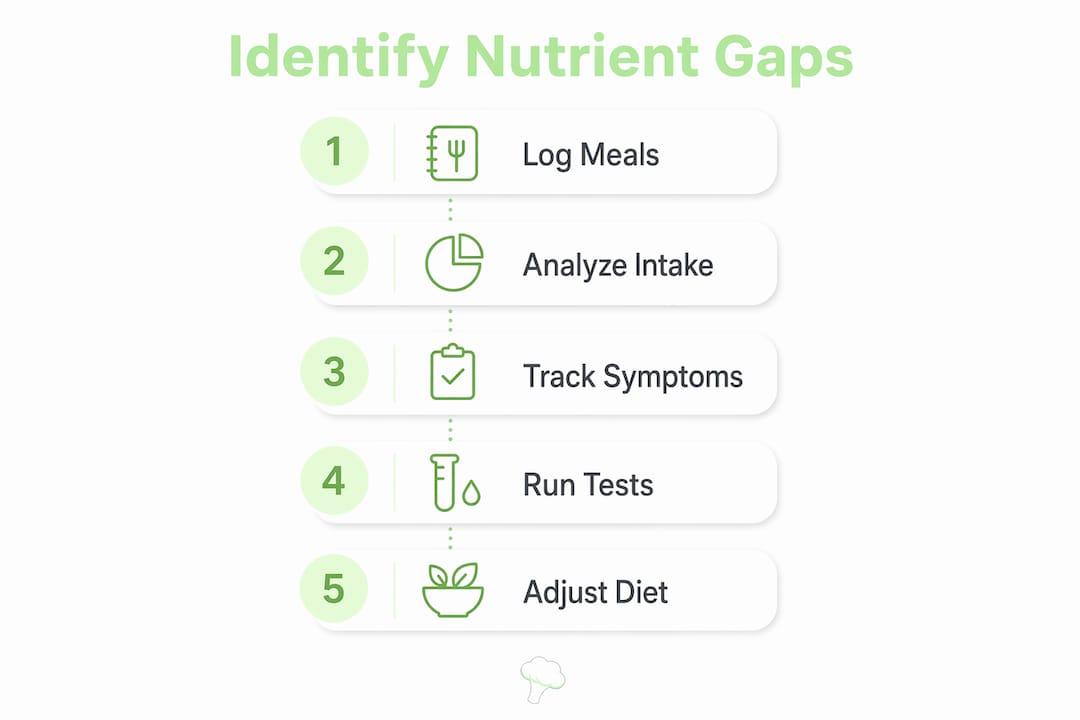
A complete nutritional gap assessment works in three layers: intake analysis, symptom tracking, and targeted testing. Skipping to testing without the first two layers leads to broad, expensive panels that generate more confusion than clarity.
Follow this framework:
Analyze your intake first. Log meals for one week using a tool that tracks micronutrients, not just calories. Bimiapp monitors over 60 nutrients, including amino acids, fatty acids, vitamins, and minerals, giving you a detailed picture of where your diet falls short relative to your personal RDAs.
Track symptoms in parallel. Keep a simple daily log of energy, mood, sleep quality, and any physical symptoms. Two weeks of data reveals patterns that a single doctor visit cannot capture.
Run a risk screener. Use a deficiency risk screener to identify which nutrients warrant clinical attention based on your diet, life stage, and risk factors.
Get targeted blood tests. Bring your intake data and symptom log to your appointment. Targeted testing based on real data is more efficient than ordering a full micronutrient panel without context.
Address gaps through food first. Whole food sources support natural absorption compounds that supplements cannot fully replicate. Use supplements to fill confirmed gaps, not as a substitute for dietary improvement.
Several factors reduce nutrient absorption regardless of intake:
Poor sleep raises cortisol, which depletes magnesium and B vitamins
Chronic stress increases demand for zinc, vitamin C, and B vitamins
Gut inflammation impairs absorption of fat-soluble vitamins (A, D, E, K) and iron
Certain medications, including proton pump inhibitors and metformin, block B12 absorption
The most common mistake is treating supplements as insurance without knowing which gaps actually exist. Supplementing broadly without testing can mask symptoms while leaving the root cause unaddressed. Test first, then supplement with purpose.
Key takeaways
Identifying hidden nutrient gaps requires combining dietary intake analysis, symptom tracking, and targeted blood testing rather than relying on any single method alone.
Point | Details |
Start with intake analysis | Log meals for one week and compare each micronutrient against your personal RDA. |
Track symptoms alongside diet | Two weeks of parallel symptom and intake data reveals patterns a single test cannot. |
Use a risk screener before testing | A deficiency risk screener narrows which nutrients need clinical attention. |
Choose sensitive blood tests | Request ferritin, RBC magnesium, and 25(OH)D for more accurate early detection. |
Fix gaps through food first | Whole food sources improve absorption; use supplements only for confirmed shortfalls. |
What I have learned from years of watching people miss their own gaps
Most people I have spoken with about nutrition assume that if something were seriously wrong, they would feel it. That assumption is the single biggest obstacle to catching gaps early. The body is remarkably good at compensating. It pulls from bone, muscle, and tissue reserves to keep blood levels stable, and it does this quietly for months or years before anything obvious surfaces.
What I find most telling is that the people who come in with confirmed deficiencies rarely describe dramatic symptoms. They describe feeling “a bit off,” sleeping poorly despite being tired, or losing focus more easily than before. These are the signals that get dismissed as stress or aging. They are worth taking seriously.
The most effective approach I have seen combines three things: consistent food logging that goes beyond calories, a symptom journal kept for at least two weeks, and a targeted conversation with a clinician armed with actual data. People who bring a week of nutrient intake data and a symptom log to their appointment get far more useful testing than those who simply report feeling tired.
My honest recommendation is to treat your nutritional biomarkers the same way you treat a financial budget. You would not assume your finances are fine without checking the numbers. Your nutrient status deserves the same attention.
— Alvi
Bimiapp makes nutritional gap monitoring practical
Tracking over 60 nutrients manually is not realistic for most people. Bimiapp handles that work automatically, using AI photo recognition to log meals and map your intake against personalized RDAs based on your age, weight, BMI, and activity level.

The platform flags shortfalls across vitamins, minerals, amino acids, and fatty acids, giving you a clear picture of where your diet falls short before you ever book a lab appointment. The Meals Vault stores your data locally so you can review trends over time and generate reports to share with your doctor. If you want a data-driven starting point for your next clinical conversation, start tracking with Bimiapp today.
FAQ
What are hidden nutrient gaps?
Hidden nutrient gaps are subclinical shortages of essential vitamins or minerals that impair body function without causing obvious symptoms. They exist because the body draws on tissue stores to keep blood levels stable, masking depletion until it becomes severe.
How do I detect nutrient deficiencies without symptoms?
Log your meals for one week and compare your intake against RDAs for key micronutrients like B12, vitamin D, iron, magnesium, and zinc. A nutrient intake analysis can reveal shortfalls before any physical sign appears.
Which blood tests are best for identifying missing vitamins?
The most sensitive tests are 25(OH)D for vitamin D, serum ferritin for iron stores, RBC magnesium for tissue magnesium status, and methylmalonic acid (MMA) for early B12 depletion. Standard panels often miss early gaps because they use reference ranges designed for clinical deficiency, not optimal function.
Can you have a nutrient gap even if your diet seems healthy?
Yes. Absorption factors like gut health, stress, sleep quality, and certain medications reduce how much of each nutrient your body actually uses. A diet that looks complete on paper can still leave gaps at the tissue level.
How much does micronutrient testing cost?
Individual tests typically cost $30–$80 each, while comprehensive micronutrient panels run $200–$400 out of pocket. Insurance coverage varies, so check with your provider before ordering a full panel.
Recommended
Comments