
Nutrient Bioaccessibility: What It Means for Your Diet


TL;DR:
Nutrient bioaccessibility is the portion of nutrients released from food during digestion and available for absorption. It determines the maximum amount of nutrients your body can use, but it is often overlooked in food labels and dietary guidelines. Proper food preparation and understanding nutrient interactions can significantly improve the bioaccessible fraction of essential nutrients.
Nutrient bioaccessibility is defined as the fraction of an ingested nutrient released from the food matrix and solubilized in gastrointestinal fluids in a potentially absorbable form. This process happens during digestion, before your body ever absorbs anything. It is the first gate a nutrient must pass through, and it determines the upper limit of what your body can even attempt to use. Understanding what is nutrient bioaccessibility changes how you think about food quality, meal preparation, and the real value of what you eat.
What is nutrient bioaccessibility and why does it matter?
Bioaccessibility is the proportion of a nutrient that becomes soluble and accessible during digestion. It is a prerequisite step that must occur before bioavailability, which is the actual absorption and use of that nutrient by your body. Think of bioaccessibility as the nutrient leaving the food and entering the digestive fluid. Only after that can absorption even begin.

This distinction matters because food composition tables represent the maximum nutrient content in a food, not what your body actually receives. A spinach salad may list 6 mg of iron per serving, but the fraction your body can access during digestion is significantly lower. Regulatory bodies like the European Food Safety Authority (EFSA) and the National Academies of Medicine (NAM) use nutrient intake data to set dietary reference values, yet those values rarely account for bioaccessibility differences across food types.
The practical implication is direct. Two foods with identical nutrient labels can deliver very different amounts of usable nutrition. Bioaccessibility is the reason why.
What happens during digestion that determines bioaccessibility?
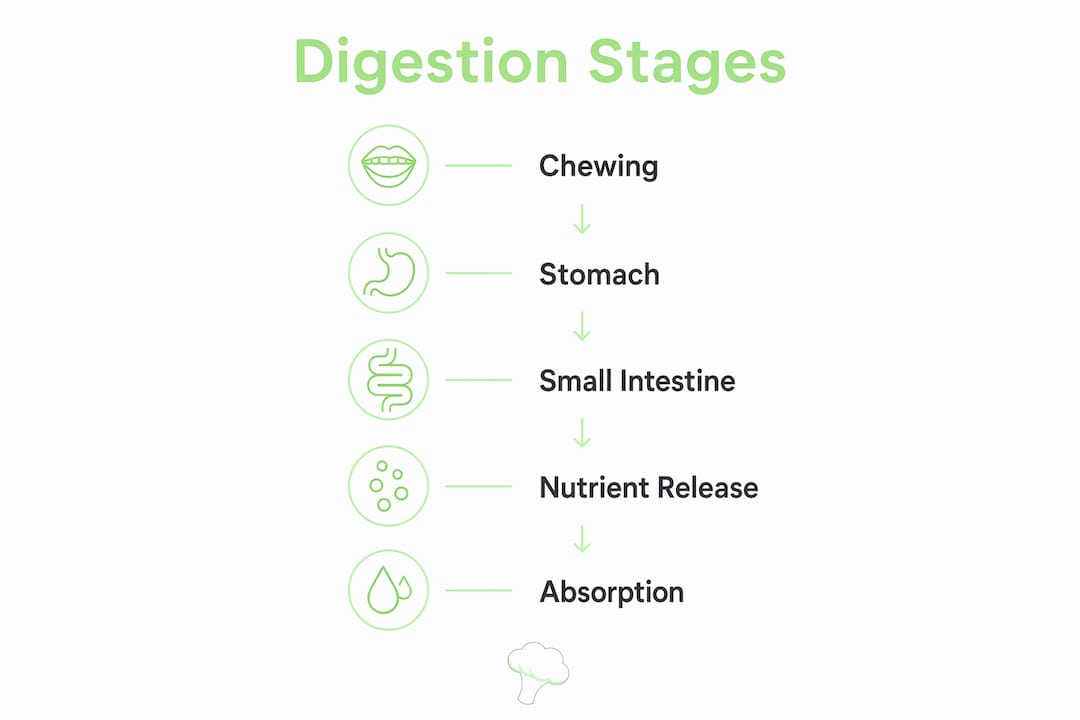
Digestion is a multi-stage process, and each stage contributes to how much of a nutrient becomes accessible. The food matrix, meaning the physical and chemical structure of the food itself, holds nutrients in place. Digestive enzymes and stomach acid must break that matrix apart before nutrients can dissolve into the surrounding fluid.
Here is how each phase contributes:
Oral phase: Chewing and salivary enzymes begin breaking down the food matrix, releasing some nutrients from cell walls and starch structures.
Gastric phase: Stomach acid (hydrochloric acid) and pepsin denature proteins and solubilize minerals like iron and zinc. This phase is critical for many micronutrients.
Intestinal phase: Pancreatic enzymes and bile salts continue breaking down fats, proteins, and complex carbohydrates. Fat-soluble vitamins like A, D, E, and K require bile for solubilization.
Solubilization: Nutrients dissolve into the intestinal fluid and become bioaccessible. Only this soluble fraction is available for transport across the intestinal wall.
In vitro digestion models simulate these phases in a laboratory to measure how much of a nutrient is released at each step. These models do not measure absorption. They measure what is released from the food, which is the definition of bioaccessibility.
Pro Tip: Chewing food thoroughly increases the surface area exposed to digestive enzymes, which directly improves nutrient release from the food matrix and raises bioaccessibility.
How does nutrient bioaccessibility differ from nutrient bioavailability?
Bioaccessibility and bioavailability are sequential, not interchangeable. Bioaccessibility does not guarantee high nutrient absorption and utilization by the body. A nutrient can be fully released from food during digestion and still fail to cross the intestinal wall in meaningful amounts.
Bioavailability in nutrition refers to the proportion of a nutrient that is absorbed into the bloodstream and made available for metabolic functions. It depends on host physiology, gut health, transporter proteins, and the presence of dietary enhancers or inhibitors. Bioaccessibility sets the ceiling. Bioavailability determines how close you get to that ceiling.
Concept | Definition | Where it occurs | What it measures |
Bioaccessibility | Fraction released and solubilized during digestion | Gastrointestinal tract | Nutrient release from food matrix |
Bioavailability | Fraction absorbed and used by the body | Intestinal wall and bloodstream | Actual nutrient uptake and utilization |
A clear example: beta-carotene in raw carrots has moderate bioaccessibility because the rigid plant cell walls limit release. Cooking the carrots breaks those walls and raises bioaccessibility. But even with high bioaccessibility, beta-carotene absorption still depends on fat intake at the same meal, since it is fat-soluble. That second step is bioavailability in food science terms.
Understanding nutrient interactions between food components is the key to connecting these two concepts in practice.
What factors affect nutrient bioaccessibility in different foods?
Food source, structure, and preparation all shape how much of a nutrient becomes accessible during digestion. Wide variability in nutrient bioavailability exists between plant-source and animal-source foods across 27 key nutrients, and this variability is consistently underestimated in dietary guidelines. That gap starts at the bioaccessibility level.
Food matrix complexity
Animal-source foods generally have simpler matrices. Nutrients in meat, fish, and dairy are bound in structures that digestive enzymes break down efficiently. Plant-source foods have cell walls made of cellulose and pectin that resist digestion. This is why heme iron from beef has higher bioaccessibility than non-heme iron from lentils.
Cooking and food processing
Heat, pressure, and fermentation all modify the food matrix. Cooking tomatoes increases lycopene bioaccessibility because heat breaks down the chromoplast structure that traps it. Fermenting grains reduces phytate content, which directly raises mineral bioaccessibility. Soaking legumes before cooking achieves a similar result.
Anti-nutrients and dietary inhibitors
Phytates and tannins in plant-based foods bind minerals like zinc, iron, and calcium during digestion and prevent their solubilization. Tannins in tea can reduce iron bioaccessibility by up to 50% when consumed with a meal. Oxalates in spinach bind calcium and limit how much becomes soluble.
Food | Nutrient | Factor limiting bioaccessibility | Preparation that helps |
Lentils | Iron | Phytates | Soaking and cooking |
Spinach | Calcium | Oxalates | Blanching |
Whole grains | Zinc | Phytates | Fermentation or soaking |
Raw carrots | Beta-carotene | Cell wall structure | Cooking with fat |
Tea consumed with meals | Iron | Tannins | Separate from iron-rich meals |
Pro Tip: Pairing vitamin C-rich foods like bell peppers or citrus with plant-based iron sources increases iron solubilization in the gut, directly raising its bioaccessibility.
How is nutrient bioaccessibility measured and applied in nutritional science?
Scientists use in vitro digestion models to estimate bioaccessibility without running human trials. These models replicate the chemical conditions of the stomach and small intestine using simulated gastric and intestinal fluids. After digestion, researchers centrifuge the samples and measure the nutrient concentration in the soluble phase. That concentration, expressed as a percentage of total nutrient content, is the bioaccessibility value.
The standard measurement process follows these steps:
Sample preparation: The food is homogenized to simulate chewing and mixed with simulated saliva.
Gastric digestion: The sample is exposed to pepsin and hydrochloric acid at body temperature for a set time period.
Intestinal digestion: Pancreatic enzymes and bile salts are added to simulate small intestine conditions.
Separation: The digested mixture is centrifuged to separate soluble and insoluble fractions.
Quantification: The nutrient concentration in the soluble fraction is measured using analytical chemistry techniques.
Nutrition algorithms for bioavailability currently exist for only a limited set of nutrients, including iron, zinc, protein, folate, and vitamins A and E. Data gaps remain for many other nutrients. This limits how precisely dietary guidelines can account for real-world absorption differences.
No globally standardized definitions for nutrient bioavailability exist across regulatory bodies, which creates inconsistency in how nutritional analysis methods are applied in food labeling and research. Standardizing in vitro methods would improve comparability across studies and eventually lead to more accurate dietary reference values.
Pro Tip: When reading nutrition research, check whether a study reports total nutrient content or bioaccessible fraction. The difference can be substantial, especially for plant-based sources of iron and zinc.
Key Takeaways
Nutrient bioaccessibility is the first and most fundamental step in the chain from food to body function, and it is consistently overlooked in standard dietary guidance.
Point | Details |
Bioaccessibility precedes bioavailability | A nutrient must be released and solubilized during digestion before absorption is possible. |
Food labels show maximum content | Actual bioaccessible fractions are often much lower, especially for plant-source nutrients. |
Anti-nutrients reduce mineral release | Phytates, tannins, and oxalates bind minerals and lower bioaccessibility in plant foods. |
Cooking raises bioaccessibility | Heat and fermentation break down food matrices and anti-nutrients, increasing nutrient release. |
Measurement gaps remain | Bioavailability algorithms exist for only a handful of nutrients, leaving most unmodeled. |
Why the food label is not the whole story
I have spent years reading nutrition research, and the single most persistent misconception I see is this: people believe that the number on a food label is the number that reaches their cells. It is not. Consumers widely misunderstand that food label nutrient content equals what the body absorbs. The label tells you what is in the food. Bioaccessibility tells you what leaves the food during digestion. Bioavailability tells you what actually gets in.
This gap has real consequences. Someone eating a plant-based diet rich in iron-containing foods may still develop iron deficiency because the bioaccessible fraction of non-heme iron is low and further reduced by phytates. They are eating enough iron on paper. They are not absorbing enough iron in practice.
The research direction I find most promising is connecting food systems to nutrition security by incorporating bioavailability and bioaccessibility data into global food models. Right now, most dietary guidelines are built on total nutrient content data. Shifting to bioaccessibility-adjusted values would change recommendations for billions of people, particularly in regions where plant-based diets dominate.
My honest view is that tracking what you eat is only useful if the data behind it reflects what your body can actually use. That requires going beyond macros and calories to look at nutrient form, food source, and preparation method.
— Alvi
Bimiapp tracks the nutrients your body actually needs
Understanding bioaccessibility is one thing. Applying it to your daily meals is another. Bimiapp is built for people who want to go beyond surface-level nutrition data.

Bimiapp tracks over 60 nutrients, including vitamins, minerals, amino acids, and fatty acids, giving you a detailed picture of your nutritional intake across every meal. The AI-powered food recognition feature lets you capture a meal photo, estimate portions, and get a full nutrient breakdown in seconds. Personalized recommendations adjust to your age, weight, BMI, and activity level, so the targets you see are relevant to your body. If you want to understand what your diet is actually delivering, start tracking with Bimiapp and see the full nutrient picture.
FAQ
What is nutrient bioaccessibility in simple terms?
Nutrient bioaccessibility is the fraction of a nutrient in food that becomes soluble during digestion and is available for absorption. It measures what leaves the food matrix, not what the body ultimately absorbs.
Is bioaccessibility the same as bioavailability?
No. Bioaccessibility is the amount released from food during digestion. Bioavailability is the amount that actually enters the bloodstream and is used by the body. Bioaccessibility is a prerequisite for bioavailability, but high bioaccessibility does not guarantee high absorption.
What reduces nutrient bioaccessibility?
Anti-nutrients like phytates, tannins, and oxalates found in plant-based foods bind minerals during digestion and reduce how much becomes soluble. Consuming tea or coffee with iron-rich meals is a common example of this effect.
How does cooking affect nutrient bioaccessibility?
Cooking breaks down cell walls and reduces anti-nutrient content, which raises the bioaccessible fraction of many nutrients. Fermenting grains and soaking legumes before cooking are two of the most effective preparation methods for improving mineral bioaccessibility.
Why do food labels not reflect bioaccessibility?
Food labels report total nutrient content measured by chemical analysis, not the fraction released during digestion. The actual bioaccessible amount depends on food matrix structure, preparation method, and the presence of dietary enhancers or inhibitors at the same meal.
Recommended
Comments