
Bio-Optimization Strategies for Personalized Health


TL;DR:
Bio-optimization uses personalized biological data and advanced tools to enhance health, performance, and recovery at the cellular level. It prioritizes baseline measurements, timing, and subtractive strategies over traditional additive approaches, leading to more precise, effective interventions. Regular biomarker feedback and phased scheduling enable tailor-made protocols that build cellular resilience and long-term well-being.
Bio-optimization is the practice of using personalized biological data and advanced techniques to enhance your body’s health, performance, and recovery at the cellular level. Unlike generic wellness programs, this approach treats your physiology as a system to be measured, understood, and adjusted with precision. It draws on clinical bloodwork, biomarker tracking, Information Biology frameworks, and technologies like Bayesian optimization to move beyond guesswork. The result is a protocol built around your specific biology, not population averages. If you track nutrients, monitor recovery, or want to get more from your health investments, bio-optimization gives you the methodology to do it right.
What is bio-optimization and how does it differ from traditional health optimization?
Bio-optimization is defined as a personalized, data-driven system for correcting and sustaining optimal physiological states. The term is widely used in health and wellness communities, but the underlying science draws from a more formal field called Information Biology, which studies how biological systems process regulatory signals rather than just molecular inputs.
Traditional health optimization focuses on adding things: supplements, calories, exercise volume. Bio-optimization takes a different starting point. True bio-optimization focuses on restoring regulatory coherence rather than simply supplementing or altering molecular components. That distinction matters because your body does not respond to inputs in isolation. It responds to patterns, timing, and context.
The Information Biology framework introduces the concept of speaking the body’s regulatory language. This means interventions are designed to match the timing and signaling patterns your physiology already uses, rather than overriding them with high-dose molecular strategies. Timing-based and subtractive signal removal strategies outperform additive molecular interventions in sustaining physiological states. Removing interference is often more effective than adding more.
Here is what separates bio-optimization from conventional approaches:
Baseline-first design. Every protocol starts with objective clinical data, not assumptions.
Regulatory state correction. The goal is coherence across systems, not isolated metric improvement.
Timing as a variable. When you intervene matters as much as what you use.
Subtractive strategies. Reducing stressors, inflammatory signals, or hormonal disruptors often outperforms adding supplements.
Iterative refinement. Protocols adjust based on biomarker feedback, not fixed schedules.
Pro Tip: Before you add a single supplement or change your diet, get a full panel of clinical bloodwork. Without a measured baseline, you are optimizing blind.
How personalized biological data drives effective bio-optimization strategies
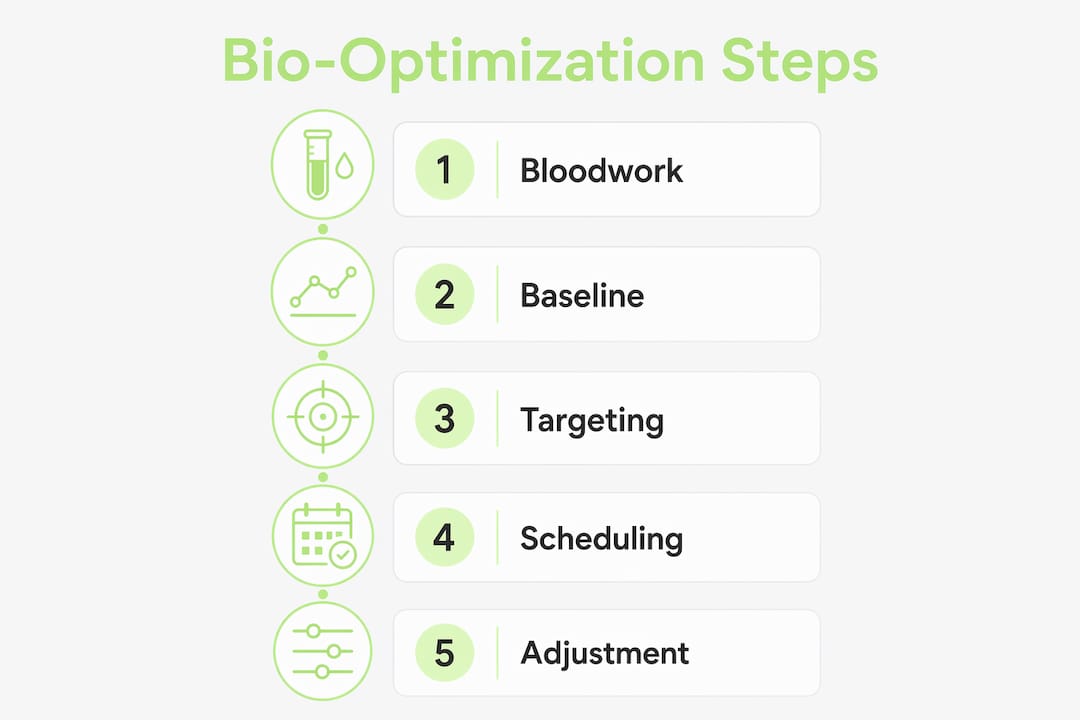
The starting point for any effective bio-optimization plan is objective measurement. Clinical baseline measurements via bloodwork are indispensable for designing precise, effective bio-optimization interventions. This is not optional. Starting without measured baselines is considered guesswork rather than science by practitioners who work in this field.

A standard entry point includes a bloodwork and consultation package covering key biomarkers across metabolic, hormonal, and inflammatory systems. From there, you build a feedback loop: measure, intervene, measure again, adjust. This cycle is what separates a personalized protocol from a generic wellness plan.
The following biomarkers form a practical starting framework for nutrition and well-being optimization:
Fasting glucose and insulin. These reveal metabolic efficiency and carbohydrate tolerance, which directly affect energy and fat storage.
hs-CRP (high-sensitivity C-reactive protein). A marker of systemic inflammation that predicts recovery capacity and chronic disease risk.
Ferritin and full iron panel. Low ferritin is one of the most common and underdiagnosed causes of fatigue and poor cognitive function.
Free and total testosterone, DHEA-S, cortisol. Hormonal markers that govern stress resilience, muscle recovery, and mood regulation.
25-OH Vitamin D. Deficiency affects immune function, mood, and bone metabolism. Many adults are deficient without knowing it.
Omega-3 index. Measures the ratio of omega-3 to omega-6 fatty acids in red blood cell membranes, a direct indicator of cardiovascular and neurological health.
If you are over 35 and training hard, objective biological metrics through clinical bloodwork become even more critical because hormonal and metabolic shifts accelerate in this period.
Once you have baseline data, Bayesian optimization methods improve how you select and sequence interventions. Integrating biological priors in optimization frameworks improves intervention efficiency by 25 to 40%. That means fewer wasted trials, faster results, and a protocol that converges on what works for your specific biology rather than what works on average.
Biomarker | What it reveals | Optimization target |
Fasting insulin | Metabolic efficiency | Below 10 µIU/mL |
hs-CRP | Systemic inflammation | Below 1.0 mg/L |
Ferritin | Iron storage and energy | 70 to 150 ng/mL |
Free testosterone | Hormonal output | Age-adjusted upper quartile |
Omega-3 index | Fatty acid balance | Above 8% |
What are the proven bio-optimization techniques and modalities available?
Biological optimization techniques span a wide range, from nutritional protocols to regenerative therapies. The most effective approaches target cellular energy production, lymphatic flow, and tissue recovery simultaneously. Stacking regenerative therapies like red light, vibration therapy, and lymphatic drainage enhances overall bio-optimization effects by addressing multiple systems at once.
Here are the primary modalities used in advanced biological optimization:
Red and near-infrared light therapy (photobiomodulation). Stimulates mitochondrial cytochrome c oxidase, increasing ATP production and reducing oxidative stress. Sessions of 10 to 20 minutes at 630 to 850 nm wavelengths are standard in clinical settings.
Micro-impact vibration therapy. Whole-body vibration at specific frequencies activates fast-twitch muscle fibers, improves lymphatic circulation, and supports bone density. It is particularly useful for recovery between training sessions.
Manual or mechanical lymphatic drainage. Clears metabolic waste from tissues, reduces inflammation, and supports immune function. Often used post-exercise or alongside detoxification protocols.
Nutritional periodization. Cycling macronutrient ratios and caloric intake in alignment with training phases and hormonal rhythms. This is distinct from simple calorie counting because it accounts for your body’s current metabolic state.
Targeted micronutrient correction. Using bloodwork data to address specific deficiencies, such as magnesium for sleep and cortisol regulation, or zinc for testosterone synthesis.
Pro Tip: Do not stack all modalities at once when starting out. Introduce one at a time over two to four weeks so you can isolate what is driving change in your biomarkers.
The comparison below shows how additive versus regulatory approaches differ in practice:
Approach | Strategy | Example | Limitation |
Additive (traditional) | Add more inputs | High-dose supplements | Ignores regulatory context |
Regulatory (bio-optimization) | Correct system state | Timed light therapy, subtractive protocols | Requires baseline data |
Stacked modalities | Combine targeted therapies | Red light plus lymphatic drainage | Needs sequencing knowledge |
How to create a personalized bio-optimization plan: scheduling, timing, and sequencing
Structuring your interventions is as important as choosing them. Optimal longevity intervention scheduling follows a structured four-phase model derived from mathematical control theory. This framework applies directly to nutrition and wellness protocols.
Interior phase (minimal intervention). When your biomarkers are within healthy ranges, use low-intensity maintenance strategies. This means consistent sleep, baseline nutrition tracking, and light activity. Heavy intervention here creates unnecessary burden without proportional benefit.
Boundary approach phase. When markers begin drifting toward suboptimal ranges, introduce targeted corrections. This might mean increasing omega-3 intake, adjusting sleep timing, or adding a specific micronutrient based on your latest bloodwork.
Constraint boundary phase. When a biomarker crosses a threshold, apply higher-intensity intervention. This could include a structured nutritional protocol, photobiomodulation sessions, or hormonal support under clinical supervision.
Recovery phase. After corrective intervention, taper back to maintenance. This phase prevents overcorrection and allows the system to stabilize at the new set point.
This phased structure is not theoretical. Phased mathematical control in longevity protocols prioritizes minimal intervention when within viable biological states, reserving high-intensity intervention for recovery post-disturbance. The practical implication: you do not need to be in maximum-effort mode all the time. Knowing when to back off is as important as knowing when to push.
Model Predictive Control takes this further by using real-time biomarker data to adjust interventions dynamically. Instead of following a fixed supplement schedule, you adjust based on what your body is actually doing. This is the direction advanced bio-optimization is moving, and tools like Bimiapp make it accessible by tracking over 60 nutrients against your personal metrics in real time.
Phase | Biomarker status | Intervention intensity | Example action |
Interior | All markers optimal | Minimal | Maintain sleep, track nutrients |
Boundary approach | One marker drifting | Low to moderate | Add targeted micronutrient |
Constraint boundary | Marker out of range | High | Structured protocol, clinical review |
Recovery | Post-correction | Tapering | Reduce intervention, retest |
Intermittent dosing schedules matching natural biological rhythms show superior longevity effects in preclinical models. This supports the practice of cycling interventions rather than applying them continuously, which aligns with how your hormonal and metabolic systems naturally operate.
What are the bio-optimization benefits for nutrition and overall well-being?
The measurable outcomes of a well-designed bio-optimization protocol are specific and trackable. Bio-optimization offers benefits including improved metabolic efficiency, stress resilience, and enhanced cellular recovery. These are not vague wellness claims. They are outcomes tied to specific biomarker changes you can verify.
Here is what you can realistically expect when you follow a data-driven biological optimization plan:
Improved nutrient absorption. Correcting deficiencies in cofactors like magnesium, zinc, and B vitamins allows your digestive and metabolic enzymes to function at full capacity. You get more from the food you already eat.
Enhanced recovery and tissue regeneration. Therapies like photobiomodulation and targeted anti-inflammatory nutrition reduce recovery time between training sessions and support connective tissue repair.
Hormonal balance and stress resilience. Correcting cortisol patterns through sleep timing, adaptogenic nutrition, and stress reduction protocols improves your capacity to handle physical and psychological load.
Metabolic efficiency gains. Aligning carbohydrate intake with insulin sensitivity rhythms reduces fat storage and improves energy availability throughout the day.
Long-term healthspan protection. Bio-optimization is inherently proactive, aiming to strengthen cellular resilience before decline occurs rather than reacting to symptoms. This is the most significant long-term benefit: you are building a buffer against future dysfunction.
Key takeaways
Effective bio-optimization requires clinical baseline data, phased intervention scheduling, and biomarker-driven feedback to produce measurable, lasting improvements in health and performance.
Point | Details |
Start with bloodwork | Clinical baselines are the non-negotiable foundation of any personalized protocol. |
Use regulatory strategies | Timing-based and subtractive interventions outperform generic supplementation. |
Follow a four-phase schedule | Match intervention intensity to your current biomarker status, not a fixed calendar. |
Stack modalities deliberately | Combine red light therapy, vibration, and lymphatic drainage for synergistic recovery gains. |
Track nutrients continuously | Monitoring over 60 nutrients against personal metrics closes the feedback loop that makes optimization real. |
Why most people are optimizing in the wrong direction
I have seen a consistent pattern in how health-conscious people approach optimization: they start with solutions before they understand the problem. Someone reads that magnesium improves sleep, so they take magnesium. Someone hears that cold exposure boosts testosterone, so they add cold plunges. Neither intervention is wrong in isolation. But without knowing your baseline, you have no way to know if it is working, or if it is even what you need.
The shift I find most clarifying is moving from an additive mindset to a regulatory one. Your body is not a machine that needs more fuel. It is a system that needs accurate signals at the right times. Speaking the body’s regulatory language through timing and information-based interventions represents the frontier of optimization science. That means your sleep schedule, your meal timing, and your light exposure are often more powerful levers than any supplement.
The technology side is genuinely exciting. Platforms that track dozens of nutrients against your personal metrics are making it possible to run a continuous feedback loop without a clinical team. But technology without interpretation is just data. The skill is learning to read what your body is telling you and adjusting accordingly. Start with data, stay curious about what it means, and resist the urge to add more before you understand what you already have.
— Alvi
Track your nutrition and start optimizing with Bimiapp
If you are ready to move from guesswork to a data-driven approach, Bimiapp gives you the tools to do it. The platform tracks over 60 nutrients, including amino acids, fatty acids, vitamins, and minerals, and generates personalized recommendations based on your age, weight, BMI, and activity level. You can capture meals using AI photo recognition, review nutrient trends over time, and identify gaps that your current diet is not covering.

Bimiapp’s Meals Vault stores your data locally so you can generate reports and spot patterns across weeks, not just days. For anyone applying a phased bio-optimization protocol, this level of nutrient visibility is what closes the feedback loop. Check out how it works and start building a protocol grounded in your actual biology, not population averages.
FAQ
What is bio-optimization in simple terms?
Bio-optimization is the practice of using personalized biological data, clinical measurements, and targeted interventions to improve your body’s health, recovery, and performance. It differs from generic wellness by starting with your specific biomarkers rather than population-level recommendations.
How do I start a bio-optimization protocol?
Start with a comprehensive bloodwork panel to establish your biological baseline. Professional bio-optimization programs begin with clinical-grade bloodwork and consultation to personalize all subsequent recommendations.
What biomarkers matter most for nutritional bio-optimization?
Key markers include fasting insulin, hs-CRP, ferritin, free testosterone, 25-OH Vitamin D, and the omega-3 index. These cover metabolic efficiency, inflammation, energy, hormonal balance, and fatty acid status, the core systems that nutritional optimization targets.
How often should I adjust my bio-optimization plan?
Adjust based on biomarker feedback, not a fixed calendar. The four-phase model recommends minimal intervention when markers are optimal and higher-intensity correction only when a specific marker drifts out of range. Retest every 8 to 12 weeks during active protocol phases.
Can nutrition tracking apps support bio-optimization?
Yes. Platforms like Bimiapp that monitor over 60 nutrients against personal metrics provide the continuous feedback loop that makes nutritional bio-optimization practical. Tracking amino acids, fatty acids, and micronutrients daily lets you catch deficiencies before they show up as symptoms.
Recommended
Comments