
Healthmaxxing: Your Practical Health Optimization Guide


TL;DR:
Healthmaxxing focuses on optimizing core biological signals like sleep, stress, and metabolism before layering nutritional and exercise habits. It emphasizes setting a strong foundation through consistent routines and evidence-based sequencing rather than extreme trends or overmaxxing nutrients. Tracking real data and addressing all health pillars synergistically lead to sustainable, long-term improvements in energy and resilience.
Healthmaxxing is defined as the practice of systematically aligning your body’s core biological signals, including sleep, stress response, and metabolic function, to build lasting energy, recovery, and resilience. Unlike viral wellness trends that push extremes, healthmaxxing as a health optimization system works by stabilizing foundational physiology first, then layering improvements in sequence. A 2026 survey of 302 patients found that only 19% have tried healthmaxxing trends despite 44% feeling informed by TikTok wellness content. That gap matters: feeling informed and being informed are two very different things.
What is healthmaxxing and why does it start with biology?
Healthmaxxing is not a checklist of extreme behaviors. It is a biological system of optimization that treats sleep, stress regulation, and metabolic flexibility as the three non-negotiable signals your body uses to run every other function. Get those signals right, and everything else, from nutrient absorption to cognitive performance, improves in response. Skip them in favor of supplements or intensity, and you are building on an unstable base.
The term itself is informal, borrowed from internet “maxxing” culture, where you maximize a specific trait. The recognized industry term for the same concept is health optimization or biohacking. Both terms describe the same goal: using evidence-based interventions to improve biological performance. Healthmaxxing simply packages that goal in a format that resonates with a younger, digitally native audience actively searching for a health improvement guide they can actually use.
What separates effective healthmaxxing from fad wellness is sequence. You do not start with a cold plunge protocol or a stack of nootropics. You start with your circadian rhythm, your cortisol curve, and your ability to burn both glucose and fat for fuel. Those three signals govern everything downstream.
What are the core pillars of healthmaxxing and why do they matter?
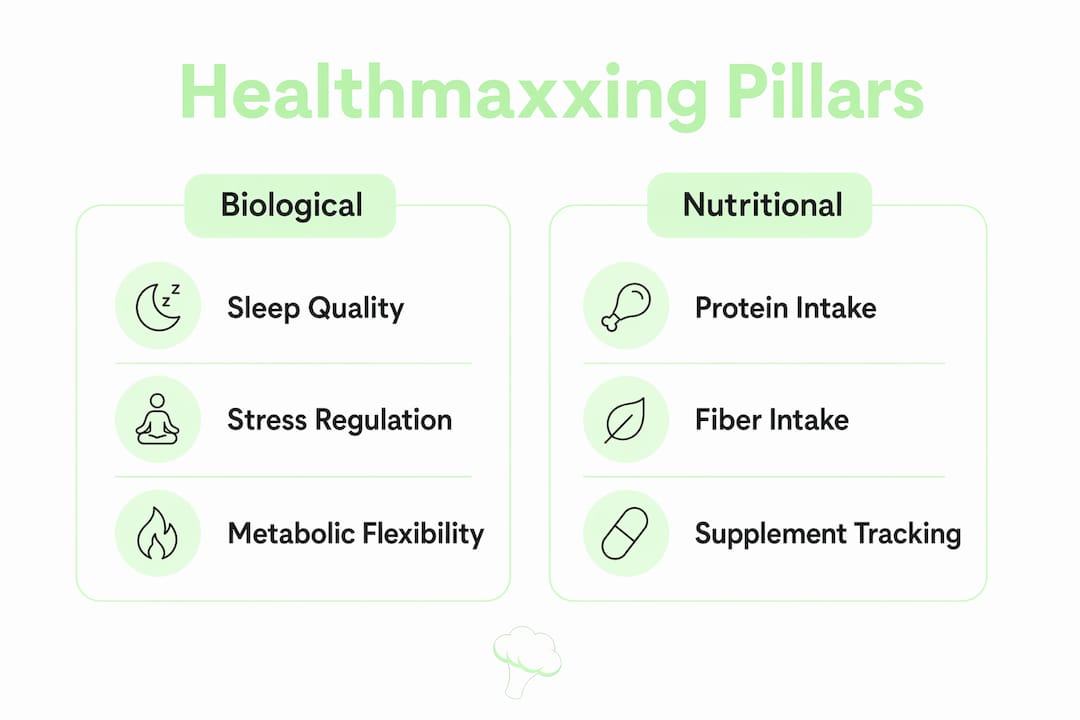
Three biological systems form the foundation of any serious wellness enhancement strategy: sleep quality, stress regulation, and metabolic flexibility.

Sleep quality and circadian alignment
Consistent, high-quality sleep is the single highest-return investment in your health. Sleep tracking tools like the Oura Ring show measurable increases in deep sleep time when users maintain a consistent bedtime and pair it with regular exercise. Deep sleep is when your body clears metabolic waste from the brain, repairs muscle tissue, and resets hormonal baselines. Without it, every other health intervention produces diminished returns.
Stress regulation
Chronic stress elevates cortisol, which suppresses immune function, disrupts sleep, and impairs glucose metabolism. Deep breathing for 5 minutes, practiced 3 to 5 times daily, reduces cortisol and anxiety according to a 2025 meta-analysis of 3,284 participants. That is a low-cost, zero-equipment intervention with measurable biological impact. Mindfulness practices from programs like MBSR (Mindfulness-Based Stress Reduction) and structured mindfulness activities also show consistent results in stress reduction research.
Metabolic flexibility
Metabolic flexibility is your body’s ability to switch efficiently between burning glucose and burning fat for fuel. A metabolically inflexible person crashes after skipping a meal or struggles with energy dips after eating carbohydrates. Building flexibility involves a combination of Zone 2 aerobic training, adequate protein intake, and avoiding chronic caloric excess. It is one of the most underrated targets in maximizing wellness, and one of the most measurable.
Aim for 7 to 9 hours of sleep per night with a consistent wake time
Practice 5 minutes of deep breathing before high-stress periods
Include at least two fasted or low-carbohydrate periods per week to train fat oxidation
Track sleep stages, not just total hours, to identify quality gaps
Pro Tip: If you can only change one thing this week, fix your wake time. A consistent wake time anchors your circadian rhythm faster than any other single intervention.
How do proteinmaxxing and fibermaxxing compare with expert recommendations?
Two of the most popular healthmaxxing sub-trends are proteinmaxxing (consuming very high protein) and fibermaxxing (maximizing fiber intake). Both are grounded in legitimate science. Both become counterproductive when taken to extremes.
Nutrient | Expert recommendation | Extreme “maxxing” approach | Risk of excess |
Protein | 1.2 to 1.6g per 2.2 lbs of body weight | 2.5g+ per 2.2 lbs daily | Kidney stones in susceptible individuals |
Fiber | 14g per 1,000 calories consumed | 50g+ daily without adjustment | Digestive distress, bloating, nutrient absorption issues |
Omega-3 | 1.1 to 1.6g daily from food sources | High-dose fish oil stacking | Blood thinning, GI discomfort |
Vitamin D | 600 to 800 IU daily (up to 2,000 IU with deficiency) | 10,000+ IU daily unsupervised | Hypercalcemia, kidney damage |
Excessive fiber beyond 14g per 1,000 calories causes digestive distress without added benefit, and excess protein raises kidney stone risk in susceptible individuals. Meeting recommended nutrient guidelines consistently outperforms exceeding them. The body has absorption ceilings. Pushing past them does not accelerate results. It creates new problems.
The deeper issue with extreme maxxing trends is that they treat nutrition as a performance variable to be maximized rather than a system to be balanced. Your nutrient balance across vitamins, minerals, amino acids, and fatty acids matters more than any single nutrient being sky-high. Deficiency in magnesium or zinc, for example, will undercut every gram of extra protein you consume.
Pro Tip: Before adding any supplement or increasing any macronutrient significantly, track your current intake for two weeks. Most people discover they are already meeting targets in some areas and genuinely deficient in others.
What practical steps can you take to start healthmaxxing effectively?
Treating healthmaxxing as a rigid checklist leads to burnout. The most effective approach is sequential and habit-based. Here is how to build it properly.
Stabilize your core signals first. Set a consistent sleep and wake time. Reduce screen exposure 60 minutes before bed. Practice one stress regulation technique daily, whether that is deep breathing, a short walk, or a body scan meditation. Eat three balanced meals with adequate protein and vegetables before worrying about optimization.
Add structured exercise. Cardiovascular health benefits from 180 to 300 minutes of Zone 2 aerobic training weekly, combined with strength training three times per week. Zone 2 means a pace where you can hold a conversation but feel the effort. This combination builds both metabolic flexibility and muscular resilience without requiring extreme training loads.
Use habit stacking to layer improvements. Habit stacking means attaching a new behavior to an existing one. Drink a glass of water when you make your morning coffee. Do five minutes of deep breathing after you sit down at your desk. Take a 10-minute walk after lunch. Each small addition compounds over weeks without requiring willpower surges.
Assess your nutrition with real data. Most people guess at their nutrient intake and guess wrong. Check your actual intake of protein, fiber, magnesium, zinc, vitamin D, and omega-3s before modifying anything. A micronutrient assessment often reveals that the biggest gains come from fixing deficiencies, not adding more of what you already have enough of.
Delay supplementation until foundations are solid. Prioritizing sleep and exercise before supplementation produces better biological resilience than starting with supplements. Supplements fill gaps in an already functional system. They do not replace the system itself.
How does healthmaxxing connect to mental, emotional, and social health?
Physical health is one component of a larger system. Healthmaxxing works best as an interconnected system treating physical, mental, emotional, spiritual, and social health synergistically, according to a 2026 expert interview with Dr. Jose Rossello. Treating only the physical pillar while ignoring the others produces incomplete results. This is where many health optimization guides fall short.
The gut-brain axis is a concrete example of this interconnection. Your gut microbiome produces roughly 90% of your body’s serotonin. Chronic stress disrupts the microbiome through elevated cortisol, which then reduces serotonin production, which worsens mood and sleep quality. That is a direct biological pathway connecting stress management to mental health to sleep quality. You cannot fix one without addressing the others.
Social health follows the same logic. Loneliness elevates cortisol and inflammatory markers at levels comparable to smoking 15 cigarettes per day, according to research from Brigham Young University. Strong social connections, whether through community, close friendships, or structured group activities, reduce baseline stress and improve adherence to health behaviors. A holistic health approach that includes social and emotional pillars consistently outperforms purely physical protocols.
Physical health: sleep, exercise, nutrition, and metabolic function
Mental health: cognitive load management, learning, and purposeful challenge
Emotional health: stress processing, self-awareness, and emotional regulation
Social health: quality relationships, community belonging, and shared purpose
Spiritual health: values alignment, meaning, and long-term direction
Each pillar feeds the others. Neglecting one creates drag on all the rest.
Key takeaways
Healthmaxxing works when you stabilize sleep, stress, and metabolic flexibility first, then build nutrition and exercise habits in sequence, avoiding extreme trends that exceed what the body can absorb.
Point | Details |
Start with biological signals | Fix sleep consistency and stress regulation before adding supplements or intensity. |
Meet nutrient targets, don’t exceed them | Excess protein and fiber cause harm; hitting recommended ranges is the actual goal. |
Use habit stacking | Attach new health behaviors to existing routines for compounding, low-effort improvement. |
Address all five health pillars | Physical, mental, emotional, social, and spiritual health interact biologically and must be treated together. |
Track real data | Guessing at nutrient intake leads to misplaced effort; measure before you modify. |
Why I think most people are optimizing in the wrong order
Most health-conscious people I have observed make the same mistake. They research the most advanced intervention they can find, whether that is peptide stacking, time-restricted eating, or cold exposure protocols, and they start there. They skip the boring part. The boring part is the part that actually works.
I have seen people spend hundreds of dollars on supplements while sleeping six hours a night and wondering why their energy is poor. Sleep deprivation alone suppresses testosterone, elevates cortisol, impairs glucose metabolism, and reduces protein synthesis. No supplement stack compensates for that. The bio-optimization sequence matters more than the specific interventions you choose.
The other trap is what I call maxxing fatigue. When you try to overhaul sleep, diet, exercise, stress management, and social health simultaneously, you burn out within three weeks and revert to baseline. The research on habit formation is clear: incremental, stacked changes outperform total overhauls every time. Pick one pillar. Stabilize it. Then add the next.
Healthmaxxing done well is not exciting. It is consistent. And consistency, compounded over months, produces results that no viral trend can match.
— Alvi
How Bimiapp supports your healthmaxxing practice
Healthmaxxing requires real data, not guesswork. Bimiapp tracks over 60 nutrients, including amino acids, vitamins, minerals, and fatty acids, giving you a precise picture of where you actually stand before you change anything.

Use Bimiapp’s AI photo recognition to log meals quickly, check your protein and fiber intake against recommended ranges, and identify genuine deficiencies instead of assuming you need more of everything. The Meals Vault stores your data locally so you can review trends over weeks, not just days. Personalized recommendations adjust to your age, weight, BMI, and activity level, so the targets you see are yours, not a generic population average. See how it works and start tracking what your body actually needs.
FAQ
What does healthmaxxing mean?
Healthmaxxing is the practice of systematically optimizing your core biological signals, including sleep, stress, and metabolism, to improve energy, recovery, and resilience. It is the informal term for what health professionals call health optimization or biohacking.
Is healthmaxxing safe?
Healthmaxxing is safe when it follows evidence-based guidelines and avoids extremes. Excessive protein and fiber intake can cause kidney stones and digestive distress, so meeting recommended nutrient ranges matters more than exceeding them.
Where do you start with healthmaxxing?
Start with sleep consistency, daily stress reduction, and balanced nutrition before adding supplements or advanced protocols. Foundations before supplementation produces better long-term biological resilience according to 2026 longevity protocol guidelines.
How much protein do you actually need for health optimization?
The recommended range is 1.2 to 1.6 grams per 2.2 pounds of body weight daily. Consuming significantly more than this does not accelerate muscle building and raises health risks in people with kidney vulnerabilities.
How does tracking nutrition help with healthmaxxing?
Tracking your actual nutrient intake reveals deficiencies and excesses that guesswork misses entirely. Tools like Bimiapp monitor over 60 nutrients and provide personalized targets, making it easier to meet your body’s real needs without overshooting.
Recommended
Comments