
Micronutrient Guide: Boost Your Health With Better Nutrition


TL;DR:
Micronutrients are essential vitamins and minerals needed in small amounts for vital bodily functions, and most must come from diet or supplements. Deficiencies in nutrients like calcium, vitamin D, and iron can cause health issues, while excess intake also poses risks, especially with fat-soluble vitamins. A diverse diet combined with personalized testing and targeted supplementation optimizes micronutrient levels and prevents deficiencies.
A micronutrient is any vitamin or mineral your body needs in small amounts to regulate metabolism, support immune function, and enable nerve signaling. The human body requires around 45 distinct micronutrients it cannot produce on its own, meaning every single one must come from your diet or a supplement. Miss enough of them consistently, and the effects show up everywhere: fatigue, weakened bones, poor immunity, and slower cognition. This guide breaks down what each type does, where the most common gaps are, and exactly how to close them.
What are the different types of micronutrients?
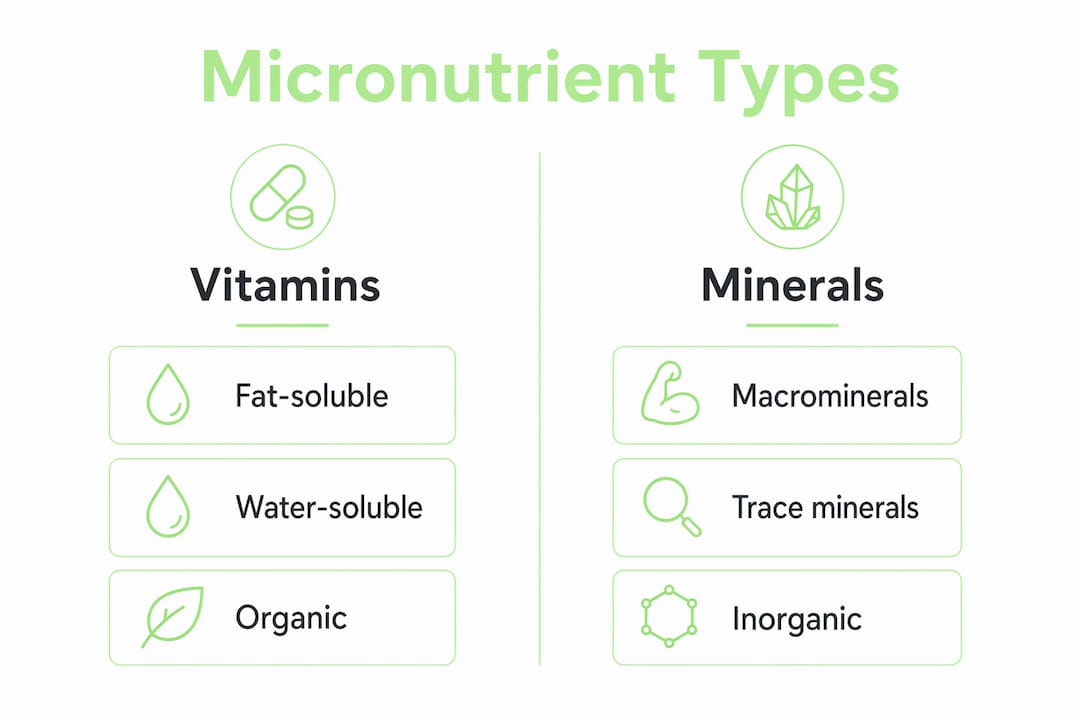
Micronutrients split into two broad categories: vitamins, which are organic compounds, and minerals, which are inorganic elements. Each group plays distinct biological roles, and understanding the difference shapes how you eat and supplement.

Fat-soluble vs. water-soluble vitamins
Fat-soluble vitamins include A, D, E, and K. Your liver and fatty tissue store them, which means they accumulate over time. That storage capacity is useful when your diet is inconsistent, but it also creates a real toxicity risk if you over-supplement. Vitamin A toxicity, for example, causes headaches, liver damage, and bone loss at sustained high doses.
Water-soluble vitamins cover vitamin C and the entire B complex, including B1, B2, B3, B5, B6, B7, B9, and B12. Your body excretes most of them regularly, so you need consistent daily intake. B12 is the notable exception: it stores in the liver for years, but absorption declines with age and with certain medications like metformin, making it a priority supplement for adults over 50.
Essential trace minerals and macrominerals
Minerals divide into macrominerals (needed in larger amounts) and trace minerals (needed in tiny amounts). Calcium, potassium, magnesium, and phosphorus are macrominerals. Iron, zinc, copper, manganese, chromium, selenium, and molybdenum are trace minerals. All of them act as enzyme cofactors, structural components of bone and tissue, or electrolytes that regulate fluid balance and nerve conduction.
Type | Examples | Storage | Key food sources | Primary function |
Fat-soluble vitamins | A, D, E, K | Liver and fatty tissue | Liver, dairy, eggs, leafy greens | Vision, bone health, clotting, antioxidant |
Water-soluble vitamins | C, B complex | Minimal (B12 excepted) | Citrus, legumes, meat, whole grains | Energy metabolism, immune defense |
Macrominerals | Calcium, magnesium, potassium | Bone and tissue | Dairy, bananas, nuts, leafy greens | Bone structure, muscle contraction, fluid balance |
Trace minerals | Iron, zinc, selenium | Limited | Red meat, shellfish, seeds, legumes | Enzyme function, immune support, thyroid health |
Pro Tip: Pair iron-rich plant foods like lentils with vitamin C sources like bell peppers. Vitamin C converts non-heme iron into a form your body absorbs up to three times more efficiently.
Why do micronutrient deficiencies and excesses both cause harm?
Getting too little is the more common problem, but getting too much of certain nutrients causes its own damage. Both ends of the spectrum impair health, and the gap between them is narrower than most people assume.
Common deficiency effects include:
Calcium deficiency: Accelerates bone loss and raises fracture risk, particularly in postmenopausal women
Vitamin D deficiency: Impairs calcium absorption, weakens immune response, and is linked to depression
Iron deficiency: Causes anemia, fatigue, and reduced cognitive performance, affecting roughly 10 million Americans
Zinc deficiency: Slows wound healing, suppresses immune function, and disrupts taste and smell
Magnesium deficiency: Contributes to muscle cramps, poor sleep, elevated blood pressure, and insulin resistance
Potassium deficiency: Raises blood pressure and increases cardiovascular risk over time
Trace elements like iron, zinc, and copper operate within narrow therapeutic windows. Excess copper, for instance, disrupts zinc absorption and damages liver tissue. Excess iron generates free radicals that accelerate cellular aging. This dual nature means more is not better. It means precise is better.
Fat-soluble vitamins carry the highest toxicity risk from supplements. Vitamin D toxicity from over-supplementation causes hypercalcemia, which leads to nausea, kidney stones, and cardiac arrhythmia. Vitamin A toxicity at doses above 10,000 IU daily over months causes liver damage and, in pregnant women, birth defects.
Pro Tip: Never self-prescribe high-dose mineral supplements without a blood panel. A standard micronutrient panel from your doctor or a lab service costs less than most supplement stacks and tells you exactly what you actually need.
How can you get enough micronutrients from food and supplements?
The most reliable foundation is a diverse, natural food diet built around fruits, vegetables, whole grains, legumes, and quality proteins. Processing strips vitamins, and aggressive cooking destroys water-soluble ones. Steaming vegetables instead of boiling them preserves significantly more folate, vitamin C, and potassium.
That said, diet alone often falls short, especially as you age. Follow these steps to build a practical intake strategy:
Audit your diet first. Log your meals for at least one week using a nutrient tracking tool. Look for consistent gaps in calcium, vitamin D, magnesium, and B12 before buying any supplement.
Prioritize food sources for most nutrients. Spinach, salmon, eggs, legumes, nuts, and fortified whole grains cover a wide range of vitamins and minerals without the toxicity risk that comes with concentrated supplements.
Add a baseline multivitamin if you are over 50. Experts recommend a daily multivitamin providing 50 to 150% of daily values for aging adults, targeting shortfall nutrients like B12, vitamin D, calcium, magnesium, and zinc.
Use targeted supplements for confirmed gaps. If a blood panel shows low vitamin D, a standalone D3 supplement at 1,000 to 2,000 IU daily is more precise than relying on a multivitamin alone.
Time your supplements correctly. Calcium and magnesium compete for absorption. Take them at separate meals. Fat-soluble vitamins absorb best with a meal containing dietary fat. Reading supplement labels carefully prevents both under-dosing and accidental stacking.
Nutrient | Recommended daily amount | Key food sources |
Calcium | 1,000–1,200 mg | Dairy, fortified plant milk, kale |
Potassium | 2,600–3,400 mg | Bananas, sweet potatoes, white beans |
Vitamin D | 600–800 IU | Fatty fish, egg yolks, fortified foods |
Magnesium | 310–420 mg | Pumpkin seeds, almonds, dark chocolate |
Vitamin B12 | 2.4 mcg | Meat, fish, dairy, fortified cereals |
Iron | 8–18 mg | Red meat, lentils, fortified grains |
Pro Tip: Supplement label percentages are based on population averages and do not account for your absorption rate, age, or medication use. A 100% daily value of B12 on a label may deliver far less than that to someone over 60 with low stomach acid.
What are the most common micronutrient gaps in modern diets?
Four nutrients are chronically under-consumed in the U.S. population: calcium, potassium, dietary fiber, and vitamin D. This is not a fringe problem. It reflects how most Americans actually eat, with diets heavy in processed foods and light on vegetables, legumes, and dairy.
The consequences compound over time. Low calcium intake across decades reduces bone density and raises osteoporosis risk. Chronic low potassium keeps blood pressure elevated, increasing the long-term risk of stroke and heart disease. Vitamin D deficiency suppresses immune function and is associated with higher rates of autoimmune conditions. Fiber shortfalls disrupt gut microbiome diversity, which in turn affects nutrient absorption, inflammation, and mental health.
Adults over 50 face additional challenges. Stomach acid production decreases with age, reducing absorption of B12, calcium, iron, and magnesium. Kidney function changes affect how the body activates vitamin D. Skin produces less vitamin D from sun exposure. Whole foods diets often fail to meet micronutrient needs for this population even when caloric intake is adequate.
Nutrient synergy matters too. Vitamin D is required for calcium absorption. Magnesium activates vitamin D. Iron absorption depends on vitamin C. These relationships mean that fixing one deficiency in isolation sometimes fails unless you address the supporting nutrients at the same time. Athletes face a parallel challenge: micronutrients in recovery directly affect muscle repair, inflammation control, and performance, making targeted intake even more critical for active individuals.
Foods that directly address the most common gaps include dark leafy greens (calcium, magnesium, folate), fatty fish like salmon and sardines (vitamin D, B12, omega-3s), white beans and lentils (potassium, iron, fiber), and pumpkin seeds (magnesium, zinc, iron).
Key takeaways
Optimizing micronutrient intake requires knowing your specific gaps, prioritizing whole foods, and supplementing only what blood testing confirms you need.
Point | Details |
Know your deficiencies | Get a blood panel before supplementing to identify actual gaps, not assumed ones. |
Food first, always | Diverse whole foods cover most micronutrient needs without toxicity risk. |
Age changes absorption | Adults over 50 need targeted attention to B12, vitamin D, calcium, and magnesium. |
Timing and pairing matter | Take calcium and magnesium separately; pair iron with vitamin C for better uptake. |
Toxicity is real | Fat-soluble vitamins and trace minerals cause harm at high doses. Precise beats more. |
Why I think most people are solving this problem backwards
Most people I talk to start with supplements and work backward to their diet. They buy a multivitamin, feel better for a week (mostly placebo), and assume the job is done. The actual problem is that they have no idea which nutrients they are actually low in.
The research is clear: blood panels reveal micronutrient status with enough precision to guide real decisions. Yet most people never get one. They guess based on symptoms, buy whatever is marketed to them, and end up either wasting money on nutrients they already have enough of or, worse, pushing fat-soluble vitamins into toxic territory.
The second mistake I see constantly is treating all supplements as equivalent. A 100% daily value of vitamin B12 in a cheap cyanocobalamin tablet does almost nothing for someone over 60 with low stomach acid. The same dose in methylcobalamin form, taken sublingually, absorbs directly into the bloodstream. Form and delivery method matter as much as dose.
My honest recommendation: track your food intake for two weeks with a tool that goes beyond calories and macros. Then get a blood panel. Then, and only then, decide what to supplement. That sequence takes maybe three weeks and saves you from years of guessing.
— Alvi
Track every micronutrient with Bimiapp

Bimiapp monitors over 60 nutrients, including all the vitamins, minerals, and trace elements covered in this article. Capture a meal photo, and the AI identifies the food, estimates the portion, and logs the full nutrient breakdown in seconds. You get a clear view of where your intake is strong and where the gaps are. Personalized recommendations adjust to your age, weight, BMI, and activity level, so the guidance you receive reflects your actual needs. Check your daily totals, review weekly trends, and make supplement decisions based on data. See how Bimiapp works and start tracking today at bimiapp.info.
FAQ
What is a micronutrient?
A micronutrient is a vitamin or mineral your body needs in small amounts to support metabolism, immune function, and cellular processes. The body cannot produce most of them, so they must come from food or supplements.
What are the most common micronutrient deficiencies in the U.S.?
Calcium, potassium, vitamin D, and dietary fiber are the four most under-consumed nutrients in the American diet. Chronic shortfalls in these nutrients raise the risk of osteoporosis, high blood pressure, and weakened immunity.
Can you get too much of a micronutrient?
Yes. Fat-soluble vitamins like A and D and trace minerals like iron and copper accumulate in the body and cause toxicity at high doses. Always confirm a deficiency with a blood test before taking high-dose supplements.
Do older adults need more micronutrients?
Adults over 50 often need more vitamin B12, vitamin D, calcium, and magnesium because absorption efficiency declines with age. A daily multivitamin providing 50 to 150% of daily values is a reasonable baseline for this group.
What foods are highest in micronutrients?
Dark leafy greens, fatty fish, eggs, legumes, nuts, seeds, and fortified whole grains provide the widest range of essential vitamins and trace minerals. Eating a variety of these foods daily covers most micronutrient needs without supplementation.
Recommended
Comments