
Nutrient Guide: Types, Sources, and Deficiency Signs


TL;DR:
Nutrients are essential substances obtained from food that support survival, growth, and tissue repair in humans. Both macronutrients and micronutrients are vital for health, with the former providing energy and structural components, and the latter regulating physiological processes. Maintaining balanced nutrient intake helps prevent deficiencies that can cause subtle health issues, while environmental nutrients differ from dietary ones and primarily impact ecosystems rather than human health.
A nutrient is a chemical substance the body uses to survive, grow, and repair tissue. Essential nutrients cannot be made in sufficient quantities by the body and must come from food. Humans require 9 essential amino acids, 2 essential fatty acids, 13 vitamins, and 14 minerals, plus choline, to function properly. Understanding what each nutrient does, where to find it, and what happens when you fall short gives you a real foundation for improving your health, managing deficiencies, or fine-tuning your diet for fitness goals.
What are the main types of nutrients?
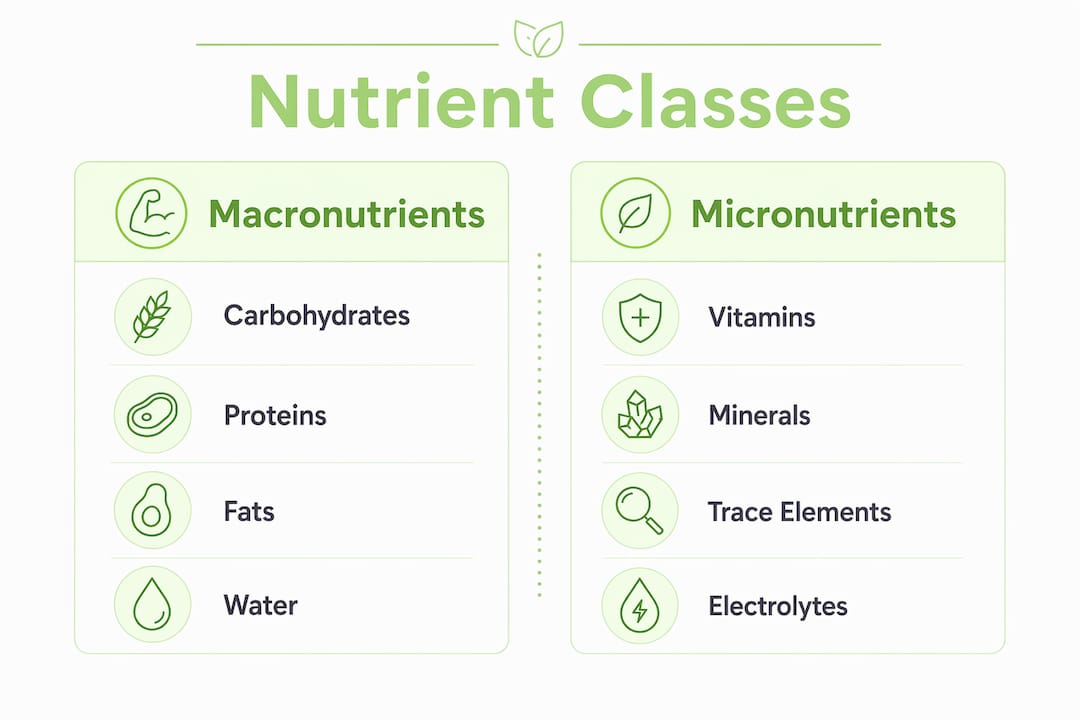
Nutrients split into two primary classes: macronutrients and micronutrients. Macronutrients and micronutrients differ mainly in the quantities your body needs, not in their importance. Both are non-negotiable for health.
Macronutrients are carbohydrates, fats, proteins, and water. Your body needs them in large amounts daily. Carbohydrates provide your primary fuel source. Proteins build and repair muscle, enzymes, and hormones. Fats support cell membranes, hormone production, and fat-soluble vitamin absorption. Water is technically a macronutrient because the body requires it in the largest volume of all.

Micronutrients are vitamins and minerals. You need them in smaller amounts, but their biochemical roles are anything but minor. Vitamins regulate enzyme reactions, nerve conduction, and immune response. Minerals like calcium, magnesium, and potassium support bone density, muscle contraction, and fluid balance.
A second useful classification separates nutrients by origin and energy yield:
Organic nutrients: contain carbon. Includes carbohydrates, proteins, fats, and vitamins.
Inorganic nutrients: no carbon. Includes water and minerals.
Energy-yielding nutrients: carbohydrates (4 kcal/g), proteins (4 kcal/g), fats (9 kcal/g).
Non-energy nutrients: vitamins, minerals, and water. They regulate processes but do not provide calories.
Nutrient class | Examples | Primary role |
Macronutrients | Carbohydrates, protein, fat | Energy, structure, hormone production |
Micronutrients | Vitamins A, C, D; iron, zinc | Enzyme function, immunity, tissue repair |
Inorganic nutrients | Calcium, potassium, water | Bone health, fluid balance |
Energy-yielding | Carbs, protein, fat | Fuel for cells and organs |
Non-energy nutrients | B vitamins, vitamin C | Metabolic regulation, antioxidant defense |
Pro Tip: Nutrients work in networks, not isolation. Vitamin D improves calcium absorption. Iron absorbs better alongside vitamin C. Build meals that pair these nutrients intentionally.
What are the best nutrient sources and how to optimize intake?
Food is your most reliable nutrient source, and variety is the mechanism that makes it work. University of Washington wellness guidance describes micronutrients as “micronutrient powerhouses” found in colorful, whole foods. Eating across the color spectrum, greens, reds, oranges, purples, and whites, covers a wider range of vitamins and minerals than any single food group can.
Here are the primary food sources for each major nutrient group:
Carbohydrates: oats, brown rice, sweet potatoes, legumes, whole-grain bread
Proteins: chicken, eggs, lentils, Greek yogurt, tofu, salmon
Healthy fats: avocado, olive oil, walnuts, chia seeds, fatty fish like mackerel
Calcium: dairy products, fortified plant milks, kale, almonds, sardines
Potassium: bananas, white beans, spinach, potatoes, acorn squash
Vitamin D: fatty fish, egg yolks, fortified cereals, sunlight exposure
Dietary fiber: lentils, black beans, pears, broccoli, flaxseed
Nutrient databases give you a precise look at what specific foods contain. Health Canada’s Canadian Nutrient File reports values for up to 152 nutrients across more than 5,690 foods. That level of detail matters because reported nutrient totals can differ substantially depending on which database you use. Always check the source when comparing food data.
Reading nutrition labels is another direct tool. The % Daily Value (%DV) on a label tells you how much of a nutrient one serving provides relative to a general daily reference. A %DV of 5% or less signals low nutrient content; 20% or more signals high content. This is a reference guide, not a personal prescription. Your actual needs vary by age, sex, weight, and activity level.
Pro Tip: When reading a label, check the %DV for fiber, calcium, potassium, and vitamin D first. These are the four nutrients most commonly under-consumed by American adults. If a food scores 20% or higher on two or more of these, it qualifies as nutrient-dense.
Understanding nutrient profiling helps you evaluate foods beyond just calories, giving you a clearer picture of their actual dietary value.
What are the symptoms and risks of nutrient deficiencies?
Nutrient deficiency symptoms are often subtle at first, which is exactly what makes them easy to miss. Common adult nutrient gaps in the U.S. include calcium, potassium, dietary fiber, and vitamin D. These four shortfalls affect bones, heart function, muscle performance, gut health, and immune response.
The most common warning signs by nutrient:
Calcium deficiency: muscle cramps, brittle nails, dental problems, and over time, reduced bone density. Recommended intake is 1,000 to 1,200 mg per day for adults.
Potassium deficiency: fatigue, muscle weakness, irregular heartbeat, and high blood pressure. Adults need 2,600 to 3,400 mg per day.
Vitamin D deficiency: bone pain, frequent illness, low mood, and fatigue. The recommended daily intake is 600 to 800 IU for most adults.
Fiber deficiency: constipation, blood sugar spikes, elevated cholesterol, and increased colorectal cancer risk. Adults need 22 to 34 grams per day.
Several factors raise your deficiency risk:
Restrictive diets that eliminate whole food groups
Malabsorption conditions like Crohn’s disease or celiac disease
Aging, which reduces absorption efficiency for calcium and vitamin B12
Limited sun exposure, which cuts vitamin D synthesis
High-intensity training without adjusted caloric or micronutrient intake
Clinical diagnosis of deficiencies combines dietary assessment with lab measurements of serum vitamins and metabolic markers. This matters because low blood nutrient levels and clinical deficiency states do not always align immediately. Symptoms can appear before lab values drop into the deficient range, or lab values can be borderline while symptoms are already present.
Pro Tip: Do not self-diagnose a deficiency and start blanket supplementation. Targeted supplementation based on lab results and dietary history prevents both under-treatment and toxicity. Nutrient excess can cause harm just as deficiency does. Work with a registered dietitian or physician to identify the root cause.
How do environmental nutrients differ from dietary nutrients?
The word “nutrient” means something different in ecology than it does in human nutrition. Mixing these frameworks creates real confusion, especially when reading health content that references nitrogen, phosphorus, or potassium in a non-dietary context.
The U.S. EPA identifies primary nutrients for plant growth as nitrogen (N), phosphorus (P), potassium (K), calcium (Ca), magnesium (Mg), sulfur (S), and silicon (Si). In aquatic ecosystems, excess nitrogen and phosphorus from agricultural runoff and wastewater cause nutrient enrichment, which triggers algal blooms and disrupts aquatic plant communities. This is nutrient pollution, not a dietary concept.
Context | Key nutrients | Primary concern |
Human nutrition | Vitamins, minerals, macronutrients | Deficiency, toxicity, metabolic function |
Plant nutrition | N, P, K, Ca, Mg, S, Si | Growth, yield, soil fertility |
Aquatic ecosystems | Nitrogen, phosphorus | Excess loading, algal blooms, ecosystem damage |
Human activities increase nutrient loadings to water bodies, and excess nutrient pollution causes measurable biological impairment in rivers, lakes, and coastal zones. This has indirect health implications through contaminated water sources, but it is a separate issue from dietary nutrient intake. When you read about nutrients in a health context, the reference is always to dietary substances your body processes for energy, structure, and regulation.
Key takeaways
Optimizing your nutrient intake requires knowing what each class does, where to find it, and how to detect and correct gaps through diet, lab testing, and targeted supplementation.
Point | Details |
Essential nutrients come from food | The body cannot make them in sufficient amounts, so diet is the primary source. |
Macronutrients and micronutrients both matter | Carbs, fats, and proteins provide energy; vitamins and minerals regulate every major body process. |
Four common deficiency gaps | Calcium, potassium, fiber, and vitamin D are the most under-consumed nutrients among American adults. |
Lab testing improves accuracy | Combining dietary assessment with serum testing gives the clearest picture of deficiency status. |
Environmental and dietary nutrients differ | Ecological nutrient concepts like N and P loading do not apply to human dietary planning. |
Why I stopped counting every nutrient and started eating smarter
I spent years tracking macros with near-obsessive precision, and what I found is that the numbers rarely told the full story. You can hit your protein target every day and still feel flat if your magnesium is low and your sleep is poor. Nutrients interact with lifestyle variables in ways that no spreadsheet fully captures.
The shift that made the biggest difference was moving from counting to pattern recognition. Eating a varied diet built around whole foods, with colorful vegetables at most meals, covers the majority of micronutrient needs without requiring you to log every gram. University of Washington wellness research supports this approach, and in practice, it is far more sustainable than precision tracking for most people.
That said, I do not dismiss tracking entirely. For anyone managing a specific deficiency, recovering from illness, or training at high intensity, knowing your numbers matters. The mistake is applying clinical-level tracking to everyday wellness without a clinical reason to do so. Get a blood panel once or twice a year. Know your actual gaps. Then build your diet around fixing what is genuinely low, not what a generic supplement label tells you to take.
— Alvi
Track every nutrient with Bimiapp

Bimiapp monitors over 60 nutrients, including amino acids, fatty acids, vitamins, and minerals, using AI-powered food recognition and personalized recommendations based on your age, weight, BMI, and activity level. You capture a meal photo, and Bimiapp analyzes its nutritional content in seconds. The Meals Vault stores your data locally so you can review trends and generate reports over time. If you want to move from guessing to knowing exactly what your diet delivers, see how it works and start tracking with precision today.
FAQ
What is a nutrient, exactly?
A nutrient is a substance an organism uses to survive, grow, and reproduce. Essential nutrients must come from food because the body cannot synthesize them in sufficient quantities.
What are the six main types of nutrients?
The six main types are carbohydrates, proteins, fats, vitamins, minerals, and water. Carbohydrates, proteins, and fats provide energy; vitamins, minerals, and water regulate bodily processes without directly supplying calories.
What are the most common nutrient deficiency symptoms?
The most common signs include fatigue, muscle cramps, brittle nails, bone pain, and digestive issues. Harvard Health identifies calcium, potassium, dietary fiber, and vitamin D as the four nutrients most frequently deficient in American adults.
How do I know if I have a nutrient deficiency?
Clinical diagnosis combines a dietary assessment with lab tests measuring serum vitamin and mineral levels. Symptoms alone are not sufficient because low blood levels and clinical deficiency states can present differently and at different times.
Can you get too many nutrients?
Yes. Nutrient excess can cause harm just as deficiency does. Fat-soluble vitamins like A, D, E, and K accumulate in the body and can reach toxic levels with excessive supplementation. Always stay within recommended intake ranges and consult a healthcare provider before starting high-dose supplements.
Recommended
Comments