
Nutrient Tracking Methodology 2026: What You Need to Know


TL;DR:
In 2026, AI-powered image recognition dominates nutrient tracking, delivering accuracy far beyond manual methods. It achieves a 2.1% calorie error rate, making it highly suitable for daily micronutrient monitoring. Combining AI tools with manual logging and regular calibration ensures more reliable dietary data for personal health optimization.
Nutrient tracking methodology in 2026 is defined by AI-powered image recognition, which delivers accuracy levels that manual logging and barcode scanning cannot match. A meta-analysis of 23 studies covering 14,847 participants found AI image-based tracking achieves a pooled calorie mean absolute percentage error (MAPE) of just 2.1%, compared to 18.3% for manual database entry. Tools like PlateLens and FRANI represent the validated front line of this shift. This article walks you through how each method compares, how AI pipelines actually work, where current methods fall short, and how to build a tracking routine that fits your health goals.
What nutrient tracking methods are available in 2026 and how do they compare?
The four primary nutrient monitoring strategies in 2026 are AI image recognition, barcode scanning, manual database entry, and food frequency questionnaires (FFQs). Each serves a different use case, and their accuracy gaps are significant enough to affect real dietary decisions.
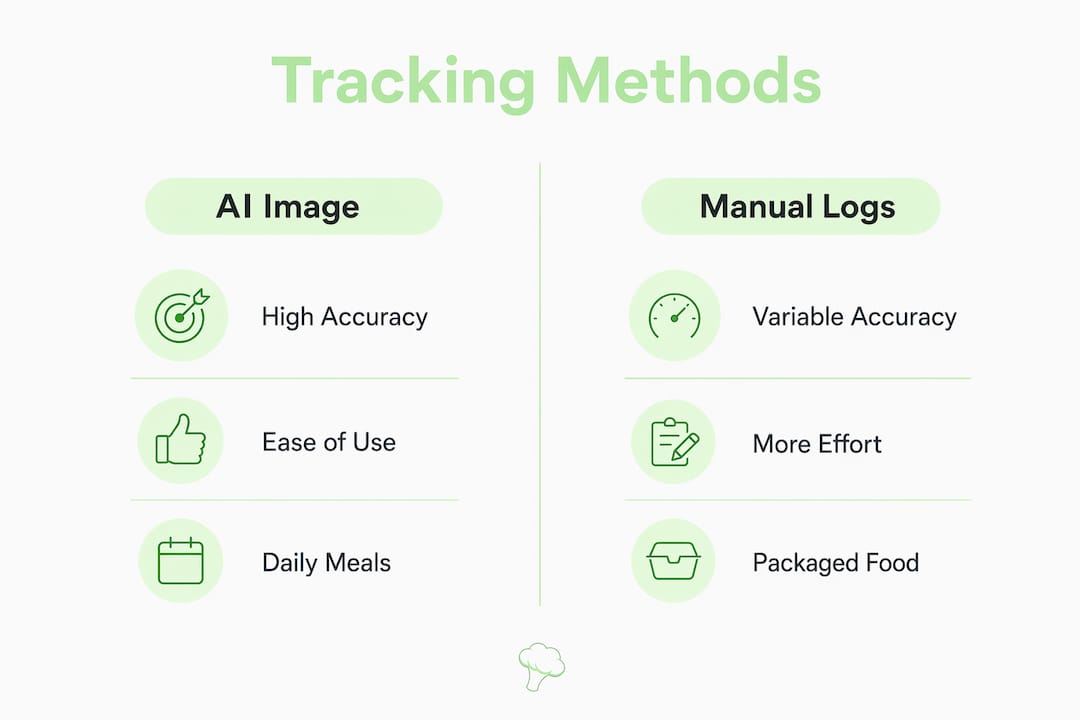
AI image recognition leads on accuracy across the board, with a pooled MAPE of 2.1% for calorie estimation. That means if your actual intake is 2,000 calories, the method is off by roughly 42 calories. Barcode scanning comes in at 8.7% MAPE, manual entry at 18.3%, and self-report recall at 31.4%. The difference between AI and manual entry is not marginal. It is the difference between actionable data and noise.
PlateLens, tested against a 180-meal weighed-food reference, achieved a photo mode MAPE of just 1.1%, the best result among six commercial apps evaluated. MyFitnessPal, which relies heavily on barcode scanning and user-submitted entries, showed error rates up to 11.2% in the same study. FRANI, validated in adolescent populations, met nutrient equivalence thresholds for energy, protein, vitamin A, fiber, iron, and zinc, with omission errors of only 2% versus 12% for traditional 24-hour recall.
Method | Calorie MAPE | Ease of use | Best for |
AI image recognition | ~2.1% | High | Daily tracking, micronutrients |
Barcode scanning | ~8.7% | High | Packaged foods only |
Manual database entry | ~18.3% | Medium | Structured meal plans |
Food frequency questionnaire | Variable | Low effort | Population-level baselines |
Pro Tip: Combine AI image recognition for daily meals with barcode scanning for packaged snacks. This hybrid approach captures the accuracy of photo-based logging where it matters most while keeping the workflow fast for simple items.
FFQs like the UK’s eNutriFFQv2.0 showed acceptable reproducibility for 25 of 29 nutrients but produced variable energy estimates across administrations. They work at the population level, not for individual optimization. If you are tracking nutrients to adjust your personal diet, an FFQ gives you a starting baseline, not a daily guide.
How do AI-powered nutrient tracking workflows actually operate?
The accuracy of AI-based tracking does not come from food recognition alone. It comes from a structured pipeline that combines image capture, volume estimation, recipe matching, and nutrient calculation. Each step builds on the last, and skipping any one of them degrades the final output.
Here is how a complete AI nutrient tracking pipeline works:
Image capture. You photograph your meal before eating. Advanced systems use RGB-D cameras or depth sensors to capture three-dimensional volume data alongside the standard color image.
Volume estimation. The system compares pre-meal and post-meal images to calculate how much of each food item was actually consumed, not just what was plated.
Recipe and ingredient matching. The identified foods are matched against a validated recipe and ingredient database, accounting for cooking methods that alter nutrient density.
Nutrient calculation. The system multiplies estimated portion weights by database nutrient values to produce a full intake report covering macros, vitamins, minerals, and more.
A hospital-based system using this exact pipeline with standardized therapeutic diet databases demonstrated high accuracy in clinical settings. The pre/post meal volume comparison step is what separates clinical-grade tools from consumer apps that only recognize food without estimating how much was eaten.
“Accurate nutrient tracking depends on integrated workflows that combine volume estimation and recipe matching rather than relying solely on food image recognition.” — Research finding from hospital meal assessment systems, 2026.
For most smartphone users, depth cameras are not yet standard. Apps like PlateLens compensate with machine learning models trained on thousands of portion sizes, using reference objects in the frame to estimate volume. The practical takeaway: photo angle and a consistent reference point in your shot (a fork, a plate of known size) meaningfully improve your results.
What are the limitations of current nutrient tracking methods?
No method in 2026 tracks all nutrients with equal accuracy. Understanding where each approach breaks down lets you compensate intelligently rather than trust your data blindly.
The most significant gap involves lipids. AI models systematically overestimate lipid content by more than 20% in controlled studies. This happens because fat is often invisible in images. Cooking oil absorbed into vegetables, butter melted into a sauce, or fat marbled through meat does not show up clearly in a photo. The AI sees a chicken breast; it cannot see how much oil it was cooked in.
Key limitations to know before you track:
Lipid overestimation: Expect AI tools to overestimate fat intake by 20% or more, particularly for cooked or restaurant meals.
Protein variability: Protein accuracy is lower than energy or carbohydrate accuracy due to cooking-related density changes and mixed-ingredient dishes.
Micronutrient gaps: Tracking vitamins and minerals requires databases with complete entries. Many apps have incomplete micronutrient data for non-packaged or ethnic foods.
Omission errors: Traditional 24-hour recall produces omission errors around 12%. AI methods reduce this to roughly 2%, but users still forget to log snacks and beverages.
Pro Tip: Log cooking fats and oils manually, even when using an AI photo app. Estimate the oil used in cooking and add it as a separate entry. This single habit corrects the most consistent source of AI tracking error.
Measurement error in self-report tools is a well-documented problem that AI methods reduce but do not eliminate. For clinical-quality applications, human-in-the-loop review remains necessary. For personal use, periodic calibration against biomarkers (such as blood lipid panels or body composition scans) helps you verify whether your tracked data reflects reality.
Micronutrient tracking deserves special attention. You can read more about why micronutrients matter and what deficiencies look like before building your tracking routine around them.
How to implement best practices for nutrient tracking in 2026
Building a reliable tracking routine requires the right tools, consistent habits, and periodic calibration. Here is a practical setup that works for most users pursuing personalized dietary optimization.
Step 1: Choose your primary tracking method. For general health and weight management, an AI photo app is the most accurate and practical choice. For clinical use or medical nutrition therapy, look for tools that integrate with validated databases and support human review of outputs.

Step 2: Set up your logging workflow. Consistency matters more than perfection. Photograph every meal from the same angle, roughly 30 to 45 cm above the plate. Include a reference object. Log within 10 minutes of eating while portion memory is fresh.
Step 3: Calibrate regularly. Every four to six weeks, cross-check your tracked data against a biomarker or a manually weighed food log for two to three days. This tells you whether your AI tool is systematically over or under-reporting any macronutrient.
Step 4: Expand beyond macros. Most users track calories, protein, carbohydrates, and fat. But nutritional deficiencies often show up in micronutrients first. Add iron, zinc, vitamin D, and omega-3 fatty acids to your monitoring targets.
Workflow | Accuracy | Effort level | Data richness |
AI photo app only | High | Low | Macros + some micros |
AI photo + manual fat logging | Very high | Medium | Macros + fats |
AI photo + periodic weighed log | Highest | Medium-high | Full nutrient profile |
FFQ baseline + AI daily tracking | High | Low ongoing | Macros + trend data |
Nutrient databases with versioning and provenance are critical for longitudinal tracking. If the database your app uses changes its values for a food item without flagging the update, your trend data becomes unreliable. When choosing a tool, check whether it documents database updates and maintains consistent unit conversions over time.
What future developments will shape nutrient tracking beyond 2026?
The next wave of 2026 nutrient tracking techniques is already in development. Wearable sensors that detect glucose, ketones, and hydration in real time will integrate with meal logging apps to create continuous dietary feedback loops. This moves tracking from a retrospective log to a live health signal.
AI models are also improving their handling of mixed dishes, ethnic cuisines, and restaurant meals, which are the hardest categories to estimate accurately today. Human-AI collaboration models, where a registered dietitian reviews flagged entries, are emerging for clinical platforms. Nutrient database standards with strict provenance and version control will become a baseline requirement for any tool used in medical nutrition therapy. The future of nutrient tracking methods points toward personalization at a level that current tools approximate but do not yet fully deliver.
Key takeaways
Effective nutrient tracking in 2026 requires AI image recognition as your primary method, combined with manual fat logging and periodic calibration to correct for systematic biases in lipid and protein estimation.
Point | Details |
AI leads on accuracy | AI image recognition achieves 2.1% MAPE, far below manual entry at 18.3%. |
Lipid bias is the biggest gap | AI tools overestimate fat by 20% or more; log cooking oils manually to compensate. |
Pipeline depth drives results | Volume estimation and recipe matching matter as much as food recognition for accuracy. |
Calibrate every 4 to 6 weeks | Cross-check tracked data against biomarkers or weighed logs to catch systematic errors. |
Expand beyond macros | Micronutrients like iron, zinc, and vitamin D require deliberate tracking, not just calorie counts. |
Why I think most people are tracking nutrients the wrong way
I have spent years watching people obsess over calorie counts while ignoring the method producing those numbers. The accuracy gap between AI photo tracking and manual entry is not a minor technical detail. It is the difference between data you can act on and data that gives you false confidence.
The most common mistake I see is treating any tracking app as equally valid. MyFitnessPal’s barcode database is convenient, but an 11.2% error rate on calories means a 220-calorie error on a 2,000-calorie day. Over a week, that adds up to more than 1,500 calories of unaccounted intake. That is not a rounding error. That is a full day of food.
What actually works is building a layered approach. Use AI photo recognition as your foundation. Log cooking fats manually. Run a two-day weighed food check every month or two. And stop expecting any single tool to be perfect for every nutrient. Lipids are hard to track from images. Protein accuracy varies with cooking method. Knowing these limits makes you a smarter user of your own data, not a frustrated one.
The bio-optimization strategies that actually move the needle on health outcomes are built on reliable data. Get the data right first, then optimize.
— Alvi
Track smarter with Bimiapp’s AI-powered nutrition tools
Bimiapp applies the same evidence-based approach described in this article. Capture a photo of your meal and Bimiapp’s AI identifies foods, estimates portions, and calculates intake across over 60 nutrients, including amino acids, fatty acids, vitamins, and minerals. The platform uses validated databases and personalized recommendations based on your age, weight, BMI, and activity level, so your targets reflect your actual physiology, not generic averages.

The Meals Vault stores your data locally, tracks trends over time, and generates reports you can bring to a dietitian or physician. If you are ready to move beyond calorie counting and into precise, data-driven nutrition, start with Bimiapp today.
FAQ
What is the most accurate nutrient tracking method in 2026?
AI image recognition is the most accurate method, achieving a pooled calorie MAPE of 2.1% across 23 studies. PlateLens specifically recorded a 1.1% MAPE against a 180-meal weighed-food reference dataset.
Why does AI tracking overestimate fat intake?
AI tools overestimate lipid content by more than 20% because cooking fats are visually hidden in images. Oil absorbed during cooking or fat marbled through meat does not appear clearly in a photograph, so the model underestimates it or misses it entirely.
How often should I calibrate my nutrient tracking data?
Calibrate every four to six weeks by comparing your tracked data against a manually weighed food log or a relevant biomarker such as a blood lipid panel. This catches systematic errors before they distort your dietary trends.
Are food frequency questionnaires useful for personal tracking?
FFQs provide a reliable population-level baseline but show variable individual estimates. Use an FFQ to establish your starting point, then switch to daily AI photo logging for ongoing personal dietary optimization.
What nutrients are hardest to track accurately?
Lipids and protein are the most difficult to track accurately due to cooking-related density changes and the visual invisibility of fats in meal images. Energy and carbohydrates are tracked most reliably, typically within a 10% margin using AI methods.
Recommended
Comments